
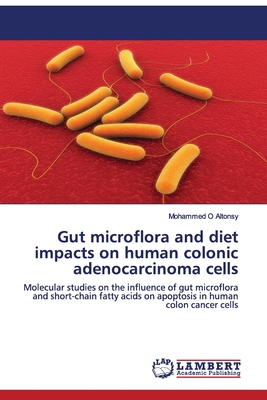
Gut microflora and diet impacts on human colonic adenocarcinoma cells
| AUTHOR | Altonsy, Mohammed O. |
| PUBLISHER | LAP Lambert Academic Publishing (04/09/2020) |
| PRODUCT TYPE | Paperback (Paperback) |
Description
The induction of apoptosis in mammalian cells by bacteria is well reported. This process may assist infection by pathogens whereas for non-pathogens apoptosis induction within carcinoma cells protects against colon cancer. Here, apoptosis induction by a major new gut bacterium, Atopobium minutum, was compared with induction by commensal (Escherichia coli K-12 strains), probiotic (Lactobacillus rhamnosus, Bifidobacterium latis) and pathogenic (E. coli: EPEC and VTEC) gut bacteria within the colon cancer cell line, Caco-2. The results show a major apoptotic effect for the pathogens, mild effects for the probiotic strains and A. minutum, but no effect for commensal E. coli. Short chain fatty acids (SCFAs) are the main fermentation products of intestinal saccharolytic bacteria in the colon and are thought to protect against colon cancer by inducing apoptosis in transformed cells. Our results confirmed that SCFAs caused morphological changes in human colonic carcinoma cell line (Caco-2) indicative of apoptosis. Analysis of various molecular markers of apoptosis (Bcl-2, caspases, cytochrome c release and cell membrane FAS levels) strongly indicated that effect.
Show More
Product Format
Product Details
ISBN-13:
9783845403465
ISBN-10:
3845403462
Binding:
Paperback or Softback (Trade Paperback (Us))
Content Language:
English
More Product Details
Page Count:
248
Carton Quantity:
32
Product Dimensions:
6.00 x 0.56 x 9.00 inches
Weight:
0.81 pound(s)
Country of Origin:
US
Subject Information
BISAC Categories
Science | Life Sciences - Biology
Descriptions, Reviews, Etc.
publisher marketing
The induction of apoptosis in mammalian cells by bacteria is well reported. This process may assist infection by pathogens whereas for non-pathogens apoptosis induction within carcinoma cells protects against colon cancer. Here, apoptosis induction by a major new gut bacterium, Atopobium minutum, was compared with induction by commensal (Escherichia coli K-12 strains), probiotic (Lactobacillus rhamnosus, Bifidobacterium latis) and pathogenic (E. coli: EPEC and VTEC) gut bacteria within the colon cancer cell line, Caco-2. The results show a major apoptotic effect for the pathogens, mild effects for the probiotic strains and A. minutum, but no effect for commensal E. coli. Short chain fatty acids (SCFAs) are the main fermentation products of intestinal saccharolytic bacteria in the colon and are thought to protect against colon cancer by inducing apoptosis in transformed cells. Our results confirmed that SCFAs caused morphological changes in human colonic carcinoma cell line (Caco-2) indicative of apoptosis. Analysis of various molecular markers of apoptosis (Bcl-2, caspases, cytochrome c release and cell membrane FAS levels) strongly indicated that effect.
Show More
Your Price
$101.32