
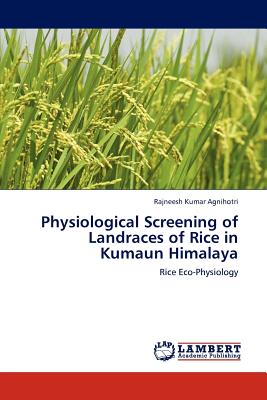
Physiological Screening of Landraces of Rice in Kumaun Himalaya
| AUTHOR | Agnihotri, Rajneesh Kumar |
| PUBLISHER | LAP Lambert Academic Publishing (08/25/2011) |
| PRODUCT TYPE | Paperback (Paperback) |
Description
The present investigations on exploration and eco-physiological studies of landraces revealed that the remote locations in the mountains for from the impact of modernization still harbor several landraces to meet local demands. As in the rice, a number of landraces are under cultivation in the mountain even today whereas these were absent in the agriculture of plains; these are being maintained by the hill farmers to meet their specific needs and are part and parcel of their traditional crop management system. If serious view of the existing situation is not taken into account, the Himalaya will become a food-importing region and loose in terms of ecological and economical security. A national system needs to be put in place to ensure effective conservation, adequate duplication and proper documentation so that the substantial gene pool can be effectively utilized. In the long run, it would be realized that conservation could only be sustainable if our national policy, supporting facilities and financial resources are sustainable.
Show More
Product Format
Product Details
ISBN-13:
9783845422510
ISBN-10:
3845422513
Binding:
Paperback or Softback (Trade Paperback (Us))
Content Language:
English
More Product Details
Page Count:
212
Carton Quantity:
38
Product Dimensions:
6.00 x 0.48 x 9.00 inches
Weight:
0.70 pound(s)
Country of Origin:
US
Subject Information
BISAC Categories
Science | Life Sciences - Botany
Descriptions, Reviews, Etc.
publisher marketing
The present investigations on exploration and eco-physiological studies of landraces revealed that the remote locations in the mountains for from the impact of modernization still harbor several landraces to meet local demands. As in the rice, a number of landraces are under cultivation in the mountain even today whereas these were absent in the agriculture of plains; these are being maintained by the hill farmers to meet their specific needs and are part and parcel of their traditional crop management system. If serious view of the existing situation is not taken into account, the Himalaya will become a food-importing region and loose in terms of ecological and economical security. A national system needs to be put in place to ensure effective conservation, adequate duplication and proper documentation so that the substantial gene pool can be effectively utilized. In the long run, it would be realized that conservation could only be sustainable if our national policy, supporting facilities and financial resources are sustainable.
Show More
Your Price
$101.32