
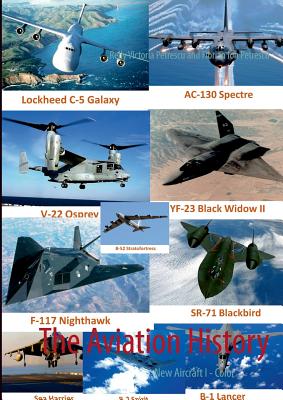
The Aviation History: New Aircraft I - Color
| AUTHOR | Petrescu, Florian Ion; Petrescu, Florian Ion Tiberiu; Petrescu, Relly Victoria |
| PUBLISHER | Bod - Books on Demand (02/15/2013) |
| PRODUCT TYPE | Paperback (Paperback) |
Description
According to Aulus Gellius, Archytas, the Ancient Greek philosopher, mathematician, astronomer, statesman, and strategist, was reputed to have designed and built, around 400 BC, the first artificial, self-propelled flying device, a bird-shaped model propelled by a jet of what was probably steam, said to have actually flown some 200 metres. This machine, which its inventor called The Pigeon, may have been suspended on a wire or pivot for its flight. The 9th century Muslim Berber inventor, Abbas Ibn Firnas's glider is considered by John Harding to be the first attempt at heavier-than-air flight in aviation history. In 1010 AD an English monk, Eilmer of Malmesbury purportedly piloted a primitive gliding craft from the tower of Malmesbury Abbey. Eilmer was said to have flown over 200 yards (180 m) before landing, breaking both his legs. He later remarked that the only reason he did not fly further was because he forgot to give it a tail, and he was about to add one when his concerned Abbot forbade him any further experiments. Bartolomeu de Gusm o, Brazil and Portugal, an experimenter with early airship designs. In 1709 demonstrated a small airship model before the Portuguese court, but never succeeded with a full-scale model. Pil tre de Rozier, Paris, France, first trip by a human in a free-flying balloon (the Montgolfi re), built by Joseph-Michel and Jacques- tienne Montgolfier, . 9 km covered in 25 minutes on October 15, 1783. (see Le Globe below for first unmanned flight, 2 months earlier) Professor Jacques Charles and Les Fr res Robert, two French brothers, Anne-Jean and Nicolas-Louis, variously shared three milestones of pioneering flight: Le Globe, the first unmanned hydrogen gas balloon flew on 26 August 1783. On 1 December 1783 La Charli re piloted by Jacques Charles and Nicolas-Louis Robert made the first manned hydrogen balloon flight. In 1951, the Lockheed XFV-1 and the Convair XFY tailsitters were both designed around the Allison YT40 turboprop engine drivin
Show More
Product Format
Product Details
ISBN-13:
9783848266395
ISBN-10:
3848266393
Binding:
Paperback or Softback (Trade Paperback (Us))
Content Language:
English
More Product Details
Page Count:
218
Carton Quantity:
20
Product Dimensions:
8.27 x 0.46 x 11.69 inches
Weight:
1.18 pound(s)
Country of Origin:
US
Subject Information
BISAC Categories
Technology & Engineering | Aeronautics & Astronautics
Descriptions, Reviews, Etc.
publisher marketing
According to Aulus Gellius, Archytas, the Ancient Greek philosopher, mathematician, astronomer, statesman, and strategist, was reputed to have designed and built, around 400 BC, the first artificial, self-propelled flying device, a bird-shaped model propelled by a jet of what was probably steam, said to have actually flown some 200 metres. This machine, which its inventor called The Pigeon, may have been suspended on a wire or pivot for its flight. The 9th century Muslim Berber inventor, Abbas Ibn Firnas's glider is considered by John Harding to be the first attempt at heavier-than-air flight in aviation history. In 1010 AD an English monk, Eilmer of Malmesbury purportedly piloted a primitive gliding craft from the tower of Malmesbury Abbey. Eilmer was said to have flown over 200 yards (180 m) before landing, breaking both his legs. He later remarked that the only reason he did not fly further was because he forgot to give it a tail, and he was about to add one when his concerned Abbot forbade him any further experiments. Bartolomeu de Gusm o, Brazil and Portugal, an experimenter with early airship designs. In 1709 demonstrated a small airship model before the Portuguese court, but never succeeded with a full-scale model. Pil tre de Rozier, Paris, France, first trip by a human in a free-flying balloon (the Montgolfi re), built by Joseph-Michel and Jacques- tienne Montgolfier, . 9 km covered in 25 minutes on October 15, 1783. (see Le Globe below for first unmanned flight, 2 months earlier) Professor Jacques Charles and Les Fr res Robert, two French brothers, Anne-Jean and Nicolas-Louis, variously shared three milestones of pioneering flight: Le Globe, the first unmanned hydrogen gas balloon flew on 26 August 1783. On 1 December 1783 La Charli re piloted by Jacques Charles and Nicolas-Louis Robert made the first manned hydrogen balloon flight. In 1951, the Lockheed XFV-1 and the Convair XFY tailsitters were both designed around the Allison YT40 turboprop engine drivin
Show More
List Price $72.50
Your Price
$71.78