
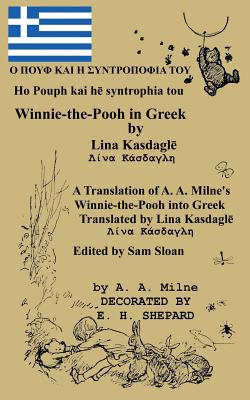
Ho Pouph kai he syntrophia tou Winnie-the-Pooh in Greek translated by Lina Kasdagle
| AUTHOR | Kasdaglē, Lina; Sloan, Sam; Milne, A. A. |
| PUBLISHER | Ishi Press (09/15/2017) |
| PRODUCT TYPE | Paperback (Paperback) (LARGE PRINT) |
Ο ΠΟΥΦ ΚΑΙ Η ΣΥΝΤΡΟΠΟΦΙΑ ΤΟΥ
Ho Pouph kai hē syntrophia tou
Winnie-the-Pooh in Greek
A Translation of A. A. Milne's Winnie-the-Pooh
Translated by Lina Kasdaglē
Winnie-the-Pooh is the most popular children's book in the world. It is somewhat less popular in Greece. The translation of this book into Greek was by Lina Kasdaglē. This translation was published in 1973. However, it was published in Polytonic Greek. This writing has been abolished in Greece since 1976. The writing system has been monotonic since then. So, it has had to be converted from Polytonic Greek to Monotonic Greek.
Lina Kasdaglē was born in Corinth, Greece in 1921. She died in Athens Greece on 19 August 2009.
The Greek Language has 11 million native speakers in the European Union and 14 million in all countries. Greek is a language read and spoken by native speakers in Albania, Macedonia, Montenegro, Cyprus and Ukraine. There is a Greek Language Wikipedia site at https: //el.wikipedia.org/ She is listed there as Λίνα Κάσδαγλη. The purpose to this series of books is to help Greek speakers learn English and to help English speakers learn Greek. To have a translation as close as possible to the original is the most useful.
Ishi Press has reprinted translations of Winnie-the-Pooh into 23 languages thus far. We have published it in Armenian, Bengali, Bulgarian, Chinese, Danish, Dutch, Esperanto, Finnish, German, Greek, Hungarian, Icelandic, Greek, Korean, Persian, Polish, Russian, Spanish, Hindi, Urdu, Khowar, Kalasha and Latin. We have six more languages line up. This translation into Greek is part of project to translate Winnie-the-Pooh into other languages. The idea is children need to learn to read at an early age and the best way to teach them to read is to provide reading materials that they find interesting. Children around the world laugh when they see Winnie-the-Pooh saying and doing silly things. Since Winnie-the-Pooh is the most popular children's book world-wide, translating this book into the different languages of the world will be conducive to teaching children to read in those languages.
Ο ΠΟΥΦ ΚΑΙ Η ΣΥΝΤΡΟΠΟΦΙΑ ΤΟΥ
Ho Pouph kai hē syntrophia tou
Winnie-the-Pooh in Greek
A Translation of A. A. Milne's Winnie-the-Pooh
Translated by Lina Kasdaglē
Winnie-the-Pooh is the most popular children's book in the world. It is somewhat less popular in Greece. The translation of this book into Greek was by Lina Kasdaglē. This translation was published in 1973. However, it was published in Polytonic Greek. This writing has been abolished in Greece since 1976. The writing system has been monotonic since then. So, it has had to be converted from Polytonic Greek to Monotonic Greek.
Lina Kasdaglē was born in Corinth, Greece in 1921. She died in Athens Greece on 19 August 2009.
The Greek Language has 11 million native speakers in the European Union and 14 million in all countries. Greek is a language read and spoken by native speakers in Albania, Macedonia, Montenegro, Cyprus and Ukraine. There is a Greek Language Wikipedia site at https: //el.wikipedia.org/ She is listed there as Λίνα Κάσδαγλη. The purpose to this series of books is to help Greek speakers learn English and to help English speakers learn Greek. To have a translation as close as possible to the original is the most useful.
Ishi Press has reprinted translations of Winnie-the-Pooh into 23 languages thus far. We have published it in Armenian, Bengali, Bulgarian, Chinese, Danish, Dutch, Esperanto, Finnish, German, Greek, Hungarian, Icelandic, Greek, Korean, Persian, Polish, Russian, Spanish, Hindi, Urdu, Khowar, Kalasha and Latin. We have six more languages line up. This translation into Greek is part of project to translate Winnie-the-Pooh into other languages. The idea is children need to learn to read at an early age and the best way to teach them to read is to provide reading materials that they find interesting. Children around the world laugh when they see Winnie-the-Pooh saying and doing silly things. Since Winnie-the-Pooh is the most popular children's book world-wide, translating this book into the different languages of the world will be conducive to teaching children to read in those languages.