
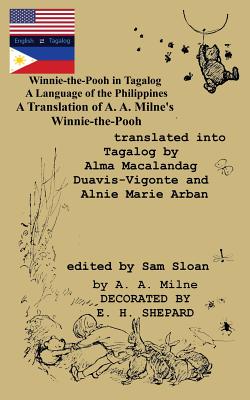
Winnie-the-Pooh in Tagalog A Language of the Philippines: A Translation of A. A. Milne's Winnie-the-Pooh
| AUTHOR | Arban, Alnie Marie; Duavis-Vigonte, Alma Macalandag; Milne, A. A. |
| PUBLISHER | Ishi Press (12/15/2017) |
| PRODUCT TYPE | Paperback (Paperback) (LARGE PRINT) |
Winnie-the-Pooh is the most popular children's book in the world. Tagalog is a language spoken as a first language by a quarter of the population of the Philippines and as a second language by the majority. Its standardized form, officially named Filipino, is the national language of the Philippines and is one of two official languages alongside English. It is spoken by 21,500,000 in Manila, most of Luzon and Mindoro. Total users in all countries are 24,628,290. We have also translated Winnie-the-Pooh into Cebuano and Visayan ISBN 4871877949
The Philippines has a population of approximately 103 million. One hundred fifty languages are spoken there. Tagalog is considered to be an Austronesian languages, a broad family of languages, comprising about 1/5th of the world's languages by number and spanning the entire Pacific and Indian Oceans.
Some dialects of Tagalog have different names for the language. Ethnic groups of Tagalog speakers call their language Lubang, Manila, Marinduque, Bataan, Batangas, Bulacan, Puray, Tanay-Paete, and Tayabas. Tagalog only relatively recently started being used as a written language. It is now taught in the schools.
Ishi Press has reprinted translations of Winnie-the-Pooh into 45 languages thus far. We have published it in Afrikaans, Albanian, Arabic, Armenian, Azerbaijani, Bengali, Bulgarian, Cebuano, Chinese, Croatian, Czech, Danish, Dutch, Esperanto, Faroese, Finnish, French, Frisian, German, Greek, Hungarian, Icelandic, Italian, Japanese, Korean, Latvian, Persian, Polish, Portuguese, Russian, Serbian, Sinhalese, Slovenian, Spanish, Swedish, Tagalog, Turkish, Ukrainian, Vietnamese, Yiddish, Hindi, Urdu, Khowar, Kalasha and Latin. We have three more languages almost ready. This translation into Tagalog is part of project to translate Winnie-the-Pooh into other languages. The idea is children need to learn to read at an early age and the best way to teach them to read is to provide reading materials they find interesting. Children around the world laugh when they see Winnie-the-Pooh saying and doing silly things. Since Winnie-the-Pooh is the most popular children's book world-wide, translating this book into the different languages of the world will be conducive to teaching children to read in those languages.
Winnie-the-Pooh is the most popular children's book in the world. Tagalog is a language spoken as a first language by a quarter of the population of the Philippines and as a second language by the majority. Its standardized form, officially named Filipino, is the national language of the Philippines and is one of two official languages alongside English. It is spoken by 21,500,000 in Manila, most of Luzon and Mindoro. Total users in all countries are 24,628,290. We have also translated Winnie-the-Pooh into Cebuano and Visayan ISBN 4871877949
The Philippines has a population of approximately 103 million. One hundred fifty languages are spoken there. Tagalog is considered to be an Austronesian languages, a broad family of languages, comprising about 1/5th of the world's languages by number and spanning the entire Pacific and Indian Oceans.
Some dialects of Tagalog have different names for the language. Ethnic groups of Tagalog speakers call their language Lubang, Manila, Marinduque, Bataan, Batangas, Bulacan, Puray, Tanay-Paete, and Tayabas. Tagalog only relatively recently started being used as a written language. It is now taught in the schools.
Ishi Press has reprinted translations of Winnie-the-Pooh into 45 languages thus far. We have published it in Afrikaans, Albanian, Arabic, Armenian, Azerbaijani, Bengali, Bulgarian, Cebuano, Chinese, Croatian, Czech, Danish, Dutch, Esperanto, Faroese, Finnish, French, Frisian, German, Greek, Hungarian, Icelandic, Italian, Japanese, Korean, Latvian, Persian, Polish, Portuguese, Russian, Serbian, Sinhalese, Slovenian, Spanish, Swedish, Tagalog, Turkish, Ukrainian, Vietnamese, Yiddish, Hindi, Urdu, Khowar, Kalasha and Latin. We have three more languages almost ready. This translation into Tagalog is part of project to translate Winnie-the-Pooh into other languages. The idea is children need to learn to read at an early age and the best way to teach them to read is to provide reading materials they find interesting. Children around the world laugh when they see Winnie-the-Pooh saying and doing silly things. Since Winnie-the-Pooh is the most popular children's book world-wide, translating this book into the different languages of the world will be conducive to teaching children to read in those languages.