
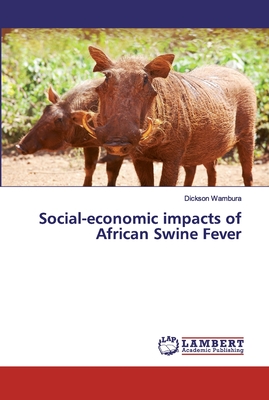
Social-economic impacts of African Swine Fever
| AUTHOR | Wambura, Dickson |
| PUBLISHER | LAP Lambert Academic Publishing (10/21/2019) |
| PRODUCT TYPE | Paperback (Paperback) |
Description
The content of this work is intended to further general scientific research, understanding, one health practices and discussion only. The common aim of many disciplines that comprise veterinary medicine is the increase in the health of animal populations, notably of domestic livestock, companion, and wild animals. This goal has traditionally been achieved by individual diagnosis and treatment. Despite traditional control techniques, for example slaughter and vaccination, some diseases like African swine fever remain at refractory levels and now require continuous scrutiny to detect changing levels of occurrence associated with ecological and management factors. The control of infectious disease has freed animals from major causes of death and economic evaluation has become important. Due to this, social economic impacts of such diseases, especially in pig industry should be assessed including how one health approaches should be applied during the outbreaks of such diseases. This fact will help to establish baseline information of ASF in urban and rural areas to guide further research, necessary interventions and formulation of control programmes of ASF.
Show More
Product Format
Product Details
ISBN-13:
9786200296511
ISBN-10:
6200296510
Binding:
Paperback or Softback (Trade Paperback (Us))
Content Language:
English
More Product Details
Page Count:
56
Carton Quantity:
126
Product Dimensions:
6.00 x 0.13 x 9.00 inches
Weight:
0.21 pound(s)
Country of Origin:
US
Subject Information
BISAC Categories
Business & Economics | General
Descriptions, Reviews, Etc.
publisher marketing
The content of this work is intended to further general scientific research, understanding, one health practices and discussion only. The common aim of many disciplines that comprise veterinary medicine is the increase in the health of animal populations, notably of domestic livestock, companion, and wild animals. This goal has traditionally been achieved by individual diagnosis and treatment. Despite traditional control techniques, for example slaughter and vaccination, some diseases like African swine fever remain at refractory levels and now require continuous scrutiny to detect changing levels of occurrence associated with ecological and management factors. The control of infectious disease has freed animals from major causes of death and economic evaluation has become important. Due to this, social economic impacts of such diseases, especially in pig industry should be assessed including how one health approaches should be applied during the outbreaks of such diseases. This fact will help to establish baseline information of ASF in urban and rural areas to guide further research, necessary interventions and formulation of control programmes of ASF.
Show More
Your Price
$51.17