
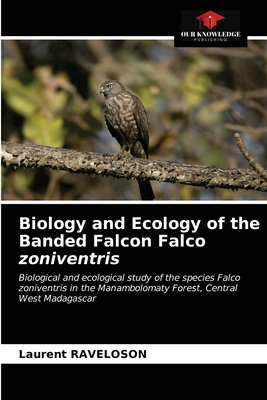
Biology and Ecology of the Banded Falcon Falco zoniventris
| AUTHOR | Raveloson, Laurent |
| PUBLISHER | Our Knowledge Publishing (05/13/2021) |
| PRODUCT TYPE | Paperback (Paperback) |
Description
The biology and ecology of the Striped Falcon Falco zoniventris, was studied on two pairs, in the Tsimembo Manambolomaty Complex Protected Area, Antsalova District, Western Madagascar, between July and December 2015. Direct and continuous observation, using a pair of binoculars and a telescope, was adopted as a study method. It lasted about 13 h of time per day, from 5:30 in the morning to 18:30 in the afternoon. The methods of listening to calls and surveying villagers were also used for locating nests and collecting prey remains for diet study.The egg-laying period took place between October and November. Each observed nest contained three white eggs with reddish brown spots. Incubation lasted an average of 31 days (varying from 30 to 32 days) (n = 2 nests). The hatching period is between November and December. The hatching rate recorded is around 83.3% for both nests. The two nests are 6400m apart. Out of 729 preys identified, the adult individuals feed mainly on chameleons (45.2%), locusts (38.7%) and mantises (5.6%).
Show More
Product Format
Product Details
ISBN-13:
9786203688078
ISBN-10:
620368807X
Binding:
Paperback or Softback (Trade Paperback (Us))
Content Language:
English
More Product Details
Page Count:
88
Carton Quantity:
80
Product Dimensions:
6.00 x 0.21 x 9.00 inches
Weight:
0.31 pound(s)
Country of Origin:
US
Subject Information
BISAC Categories
Science | Life Sciences - Biology
Descriptions, Reviews, Etc.
publisher marketing
The biology and ecology of the Striped Falcon Falco zoniventris, was studied on two pairs, in the Tsimembo Manambolomaty Complex Protected Area, Antsalova District, Western Madagascar, between July and December 2015. Direct and continuous observation, using a pair of binoculars and a telescope, was adopted as a study method. It lasted about 13 h of time per day, from 5:30 in the morning to 18:30 in the afternoon. The methods of listening to calls and surveying villagers were also used for locating nests and collecting prey remains for diet study.The egg-laying period took place between October and November. Each observed nest contained three white eggs with reddish brown spots. Incubation lasted an average of 31 days (varying from 30 to 32 days) (n = 2 nests). The hatching period is between November and December. The hatching rate recorded is around 83.3% for both nests. The two nests are 6400m apart. Out of 729 preys identified, the adult individuals feed mainly on chameleons (45.2%), locusts (38.7%) and mantises (5.6%).
Show More
Your Price
$70.41