
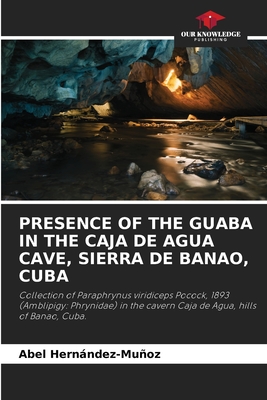
Presence of the Guaba in the Caja de Agua Cave, Sierra de Banao, Cuba
| AUTHOR | Hernndez-Muoz, Abel |
| PUBLISHER | Our Knowledge Publishing (05/28/2024) |
| PRODUCT TYPE | Paperback (Paperback) |
Description
The main data on the presence of Paraphrynus viridiceps, an amblypygid known from Cuba, which belongs to the genus Paraphrynus Moreno, 1940 (Phrynidae). It is the species Paraphrynus viridiceps (Pocock, 1893). The Guabá is an arachnid member of the Order Amblipygy of medium size and dorsoventrally flattened body. At first glance they look like spiders, but unlike spiders they have clearly segmented abdomens, relatively large and spiny pedipalps, and the first pair of legs is very elongated, whip-shaped, and their life habits are eminently nocturnal. Generally, during the day they take shelter under stones and the semi-detached bark of trees, although a considerable number of species preferentially inhabit caves, grottos and caverns (troglophilic species), while several are strict cavers (troglobic) and others have adapted to coexist with humans (synanthropic).The guabaes feed mostly on arthropods (insects, spiders and mealybugs). These animals have been detected, recorded and connected from subway cavities excavated in central Cuba.
Show More
Product Format
Product Details
ISBN-13:
9786207594962
ISBN-10:
6207594967
Binding:
Paperback or Softback (Trade Paperback (Us))
Content Language:
English
More Product Details
Page Count:
60
Carton Quantity:
118
Product Dimensions:
6.00 x 0.14 x 9.00 inches
Weight:
0.22 pound(s)
Country of Origin:
US
Subject Information
BISAC Categories
Science | Life Sciences - Zoology - General
Descriptions, Reviews, Etc.
publisher marketing
The main data on the presence of Paraphrynus viridiceps, an amblypygid known from Cuba, which belongs to the genus Paraphrynus Moreno, 1940 (Phrynidae). It is the species Paraphrynus viridiceps (Pocock, 1893). The Guabá is an arachnid member of the Order Amblipygy of medium size and dorsoventrally flattened body. At first glance they look like spiders, but unlike spiders they have clearly segmented abdomens, relatively large and spiny pedipalps, and the first pair of legs is very elongated, whip-shaped, and their life habits are eminently nocturnal. Generally, during the day they take shelter under stones and the semi-detached bark of trees, although a considerable number of species preferentially inhabit caves, grottos and caverns (troglophilic species), while several are strict cavers (troglobic) and others have adapted to coexist with humans (synanthropic).The guabaes feed mostly on arthropods (insects, spiders and mealybugs). These animals have been detected, recorded and connected from subway cavities excavated in central Cuba.
Show More
Your Price
$57.00