
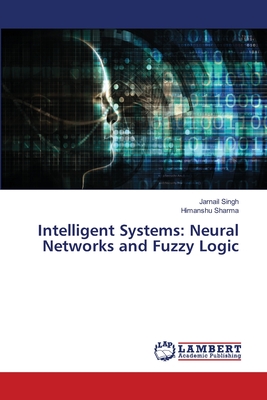
Intelligent Systems: Neural Networks and Fuzzy Logic
| AUTHOR | Singh, Jarnail; Sharma, Himanshu |
| PUBLISHER | LAP Lambert Academic Publishing (06/25/2025) |
| PRODUCT TYPE | Paperback (Paperback) |
Description
Neural networks and fuzzy logic are two key areas of artificial intelligence that replicate aspects of human cognition. Neural networks are inspired by the brain's structure, consisting of interconnected neurons that process and learn from data. They are capable of supervised, unsupervised, and reinforcement learning, and are used in applications like pattern recognition, optimization, and speech processing. Key models include the perceptron, Hopfield networks, radial basis function networks, and Kohonen's self-organizing maps. Learning mechanisms involve weight adjustments based on input patterns and feedback. Fuzzy logic, on the other hand, deals with reasoning under uncertainty using fuzzy sets, linguistic variables, and membership functions. It contrasts with traditional binary logic by allowing partial truth values. Fuzzy systems use inference rules and defuzzification techniques to make decisions and are widely applied in control systems such as anti-lock braking systems (ABS) and industrial automation. Both paradigms are also being implemented in hardware, including VLSI, for faster and more efficient processing.
Show More
Product Format
Product Details
ISBN-13:
9786208447373
ISBN-10:
6208447372
Binding:
Paperback or Softback (Trade Paperback (Us))
Content Language:
English
More Product Details
Page Count:
96
Carton Quantity:
72
Product Dimensions:
6.00 x 0.23 x 9.00 inches
Weight:
0.31 pound(s)
Country of Origin:
US
Subject Information
BISAC Categories
Computers | Networking - General
Descriptions, Reviews, Etc.
publisher marketing
Neural networks and fuzzy logic are two key areas of artificial intelligence that replicate aspects of human cognition. Neural networks are inspired by the brain's structure, consisting of interconnected neurons that process and learn from data. They are capable of supervised, unsupervised, and reinforcement learning, and are used in applications like pattern recognition, optimization, and speech processing. Key models include the perceptron, Hopfield networks, radial basis function networks, and Kohonen's self-organizing maps. Learning mechanisms involve weight adjustments based on input patterns and feedback. Fuzzy logic, on the other hand, deals with reasoning under uncertainty using fuzzy sets, linguistic variables, and membership functions. It contrasts with traditional binary logic by allowing partial truth values. Fuzzy systems use inference rules and defuzzification techniques to make decisions and are widely applied in control systems such as anti-lock braking systems (ABS) and industrial automation. Both paradigms are also being implemented in hardware, including VLSI, for faster and more efficient processing.
Show More
Your Price
$84.31