
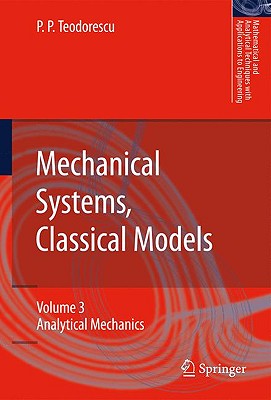
Mechanical Systems, Classical Models: Volume III: Analytical Mechanics
| AUTHOR | Teodorescu, Petre P. |
| PUBLISHER | Springer (08/04/2009) |
| PRODUCT TYPE | Hardcover (Hardcover) |
Description
All phenomena in nature are characterized by motion. Mechanics deals with the objective laws of mechanical motion of bodies, the simplest form of motion. In the study of a science of nature, mathematics plays an important rle. Mechanics is the first science of nature which has been expressed in terms of mathematics, by considering various mathematical models, associated to phenomena of the surrounding nature. Thus, its development was influenced by the use of a strong mathematical tool. As it was already seen in the first two volumes of the present book, its guideline is precisely the mathematical model of mechanics. The classical models which we refer to are in fact models based on the Newtonian model of mechanics, that is on its five principles, i.e.: the inertia, the forces action, the action and reaction, the independence of the forces action and the initial conditions principle, respectively. Other models, e.g., the model of attraction forces between the particles of a discrete mechanical system, are part of the considered Newtonian model. Kepler's laws brilliantly verify this model in case of velocities much smaller then the light velocity in vacuum.
Show More
Product Format
Product Details
ISBN-13:
9789048127634
ISBN-10:
9048127637
Binding:
Hardback or Cased Book (Sewn)
Content Language:
English
More Product Details
Page Count:
772
Carton Quantity:
12
Product Dimensions:
6.14 x 1.63 x 9.21 inches
Weight:
2.79 pound(s)
Feature Codes:
Bibliography,
Index,
Table of Contents,
Illustrated
Country of Origin:
NL
Subject Information
BISAC Categories
Science | Mechanics - General
Science | Applied
Science | Physics - Mathematical & Computational
Dewey Decimal:
531.16
Descriptions, Reviews, Etc.
publisher marketing
All phenomena in nature are characterized by motion. Mechanics deals with the objective laws of mechanical motion of bodies, the simplest form of motion. In the study of a science of nature, mathematics plays an important rle. Mechanics is the first science of nature which has been expressed in terms of mathematics, by considering various mathematical models, associated to phenomena of the surrounding nature. Thus, its development was influenced by the use of a strong mathematical tool. As it was already seen in the first two volumes of the present book, its guideline is precisely the mathematical model of mechanics. The classical models which we refer to are in fact models based on the Newtonian model of mechanics, that is on its five principles, i.e.: the inertia, the forces action, the action and reaction, the independence of the forces action and the initial conditions principle, respectively. Other models, e.g., the model of attraction forces between the particles of a discrete mechanical system, are part of the considered Newtonian model. Kepler's laws brilliantly verify this model in case of velocities much smaller then the light velocity in vacuum.
Show More
List Price $219.99
Your Price
$217.79