
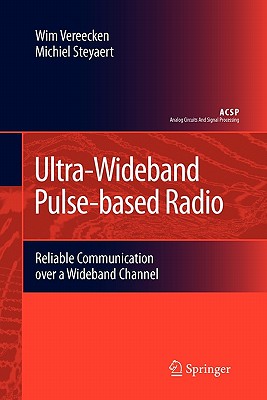
Ultra-Wideband Pulse-Based Radio: Reliable Communication Over a Wideband Channel
| AUTHOR | Vereecken, Wim; Steyaert, Michiel |
| PUBLISHER | Springer (10/28/2010) |
| PRODUCT TYPE | Paperback (Paperback) |
Description
Today's booming expanse of personal wireless radio communications is a rich source of new challenges for the designer of the underlying enabling te- nologies. Personal communication networks are designed from a fundam- tally different perspective than broadcast service networks, such as radio and television. While the focus of the latter is on reliability and user comfort, the emphasis of personal communication devices is on throughput and mobility. However, because the wireless channel is a shared transmission medium with only very limited resources, a trade-off has to be made between mobility and the number of simultaneous users in a con?ned geographical area. Accord- 1 ing to Shannon's theorem on channel capacity, the overall data throughput of a communication channel bene?ts from either a linear increase of the tra- mission bandwidth, or an (equivalent) exponential increase in signal quality. Consequently, it is more bene?cial to think in terms of channel bandwidth than it is to pursue a high transmission power. All the above elements are embodied in the concept of spatial ef?ciency. By describing the throughput of a system 2 in terms of bits/s/Hz/m, spatial ef?ciency takes into account that the use of a low transmission power reduces the operational range of a radio transmission, and as such enables a higher reuse rate of the same frequency spectrum.
Show More
Product Format
Product Details
ISBN-13:
9789048185030
ISBN-10:
9048185033
Binding:
Paperback or Softback (Trade Paperback (Us))
Content Language:
English
More Product Details
Page Count:
247
Carton Quantity:
32
Product Dimensions:
6.14 x 0.56 x 9.21 inches
Weight:
0.84 pound(s)
Country of Origin:
NL
Subject Information
BISAC Categories
Technology & Engineering | Electronics - Circuits - General
Dewey Decimal:
621.381
Descriptions, Reviews, Etc.
publisher marketing
Today's booming expanse of personal wireless radio communications is a rich source of new challenges for the designer of the underlying enabling te- nologies. Personal communication networks are designed from a fundam- tally different perspective than broadcast service networks, such as radio and television. While the focus of the latter is on reliability and user comfort, the emphasis of personal communication devices is on throughput and mobility. However, because the wireless channel is a shared transmission medium with only very limited resources, a trade-off has to be made between mobility and the number of simultaneous users in a con?ned geographical area. Accord- 1 ing to Shannon's theorem on channel capacity, the overall data throughput of a communication channel bene?ts from either a linear increase of the tra- mission bandwidth, or an (equivalent) exponential increase in signal quality. Consequently, it is more bene?cial to think in terms of channel bandwidth than it is to pursue a high transmission power. All the above elements are embodied in the concept of spatial ef?ciency. By describing the throughput of a system 2 in terms of bits/s/Hz/m, spatial ef?ciency takes into account that the use of a low transmission power reduces the operational range of a radio transmission, and as such enables a higher reuse rate of the same frequency spectrum.
Show More
List Price $169.99
Your Price
$168.29