
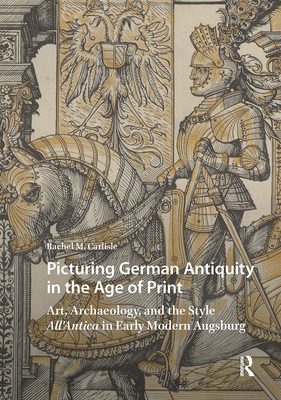
Picturing German Antiquity in the Age of Print: Art, Archaeology, and the Style All'antica in Early Modern Augsburg
| AUTHOR | Carlisle, Rachel |
| PUBLISHER | Routledge (12/02/2024) |
| PRODUCT TYPE | Hardcover (Hardcover) |
Picturing German Antiquity in the Age of Print: Art, Archaeology, and the Style All'antica in Early Modern Augsburg examines the central role of print to local antiquarian pursuits and generation of a style all'antica in early sixteenth-century Augsburg, Germany. Working in the shadow of Holy Roman Emperor Maximilian I, Augsburg's leading patrons, including humanist Konrad Peutinger and the mercantile Fugger family, documented local antiquities and commissioned new works of classicizing art and architecture, visually asserting a genuine, unbroken lineage to the city's past. This study challenges earlier narratives by arguing that Augsburg's artists and printers did not directly copy Italian Renaissance models but instead manipulated the imported visual vocabulary according to local concerns. The book brings together scholarly discourses on transalpine exchange, scientific advancements in printmaking, and reception of antiquity north of the Alps to offer a new understanding of art in early modern Augsburg and northern Europe at large.
Picturing German Antiquity in the Age of Print: Art, Archaeology, and the Style All'antica in Early Modern Augsburg examines the central role of print to local antiquarian pursuits and generation of a style all'antica in early sixteenth-century Augsburg, Germany. Working in the shadow of Holy Roman Emperor Maximilian I, Augsburg's leading patrons, including humanist Konrad Peutinger and the mercantile Fugger family, documented local antiquities and commissioned new works of classicizing art and architecture, visually asserting a genuine, unbroken lineage to the city's past. This study challenges earlier narratives by arguing that Augsburg's artists and printers did not directly copy Italian Renaissance models but instead manipulated the imported visual vocabulary according to local concerns. The book brings together scholarly discourses on transalpine exchange, scientific advancements in printmaking, and reception of antiquity north of the Alps to offer a new understanding of art in early modern Augsburg and northern Europe at large.