
Back to Search

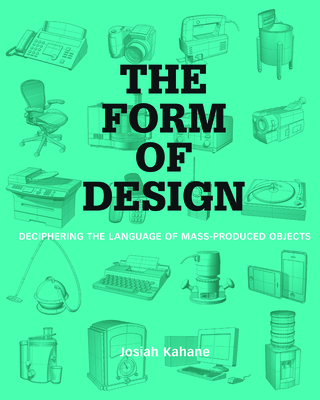
The Form of Design: Deciphering the Language of Mass Produced Objects

AUTHOR Kahane, Josiah
PUBLISHER Bis Publishers (06/02/2015)
PRODUCT TYPE Paperback (Paperback)

Description

This is the first all-encompassing book about the visual language of man-made products, explaining how mass-produced objects evolve over time and what made them change. Form evolution behaves in a similar way to language evolution and, to some extent, even to natural evolution. In the book the author materializes the governing rules of form evolution by means of fourteen case studies.


Show More
Product Format
Product Details
ISBN-13: 9789063693756
ISBN-10: 9063693753
Binding: Paperback or Softback (Trade Paperback (Us))
Content Language: English
More Product Details
Page Count: 240
Carton Quantity: 20
Product Dimensions: 7.90 x 0.70 x 9.70 inches
Weight: 1.60 pound(s)
Feature Codes: Bibliography, Price on Product, Illustrated
Country of Origin: NL
Subject Information
BISAC Categories
Design | Industrial
Design | Creative Ability
Design | Creativity
Dewey Decimal: 745.4
Descriptions, Reviews, Etc.
jacket back
Why, in spite of widespread designers' obsession with amazing bicycle concepts, bicycles still essentially adhere to traditional classic form? Why, in spite of countless car makes and models, the underlying car meta-form, is basically the same? On the other hand, why does our understanding of the word "chair" allow an extreme latitude of form variety? Why do kitchen appliances such as mixers and toasters, insist on retaining a specific form for each assigned function? These are some of the questions this book answers.

The Form of Design is the first all-encompassing book about the visual language of man-made products. It explains how mass produced objects evolve over time and what made them change. Form evolution behaves in a similar way to language evolution and to some extent, even to natural evolution. In the book the author materializes the governing rules of form evolution by means of 14 case studies. These case studies encompass a diversity of product families such as smart phones and bicycles, coffee machines and chairs, TV screens and cooling fans, accompanied by charts and numerous illustrations that lluminate and elucidate the evolutionary processes involved.This book is not a historical review of thousands of years of evolution of man-made tools, artifacts and objects; it specifically focuses on recent, present and future trends.

The accumulated cultural, cognitive science and design research knowledge is dealt with in part 1.
Part 2 lay down the authors concepts of form.
Then Part 3, the mainstay of the book (occupying about two thirds of the content), is devoted to the stories of the fourteen case studies.

Show More
jacket front
Why, in spite of widespread designers' obsession with amazing bicycle concepts, bicycles still essentially adhere to traditional classic form? Why, in spite of countless car makes and models, the underlying car meta-form, is basically the same? On the other hand, why does our understanding of the word "chair" allow an extreme latitude of form variety? Why do kitchen appliances such as mixers and toasters, insist on retaining a specific form for each assigned function? These are some of the questions this book answers.

The Form of Design is the first all-encompassing book about the visual language of man-made products. It explains how mass produced objects evolve over time and what made them change. Form evolution behaves in a similar way to language evolution and to some extent, even to natural evolution. In the book the author materializes the governing rules of form evolution by means of 14 case studies. These case studies encompass a diversity of product families such as smart phones and bicycles, coffee machines and chairs, TV screens and cooling fans, accompanied by charts and numerous illustrations that lluminate and elucidate the evolutionary processes involved.This book is not a historical review of thousands of years of evolution of man-made tools, artifacts and objects; it specifically focuses on recent, present and future trends.

The accumulated cultural, cognitive science and design research knowledge is dealt with in part 1.
Part 2 lay down the authors concepts of form.
Then Part 3, the mainstay of the book (occupying about two thirds of the content), is devoted to the stories of the fourteen case studies.

Show More
publisher marketing

This is the first all-encompassing book about the visual language of man-made products, explaining how mass-produced objects evolve over time and what made them change. Form evolution behaves in a similar way to language evolution and, to some extent, even to natural evolution. In the book the author materializes the governing rules of form evolution by means of fourteen case studies.


Show More
List Price $45.00
Your Price  $44.55
Paperback