
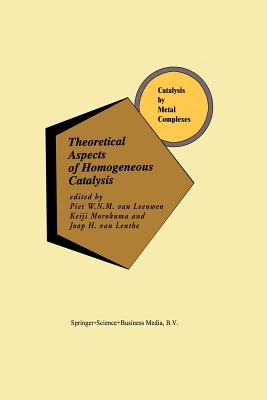
Theoretical Aspects of Homogeneous Catalysis: Applications of AB Initio Molecular Orbital Theory
| PUBLISHER | Springer (10/05/2012) |
| PRODUCT TYPE | Paperback (Paperback) |
Description
Homogeneous catalysis plays an important role both in the laboratory and in the industry. Successful applications in industry involve new polymerisation processes with complexes of zirconium and related metals, new carbonylation processes employing palladium and rhodium, ring opening polymerisations, and new enantioselective isomerisation catalysts as in the preparation of menthol. Also in the synthesis of organic compounds in the laboratory highly selective homogeneous catalysts represent an irreplaceable part of the toolbox of the synthetic chemist. Examples of such reactions are cross-coupling (Ni, Pd), nucleophilic substitution of allylpalladium complexes, Heck reactions (Pd), asymmetric epoxidation, Wacker type reactions (Pd), asymmetric hydrogenations (Rh, Ru), reactions of chromium complexes, enantioselective reactions with Lewis acids, reactions with the McMurry reagent, etc. There is hardly any multistep organic synthesis that does not involve one of these metal catalysed reactions. Most of these catalysts have been developed by empiricism. The metal catalysed processes consist of a series of elementary steps which often have been studied in isolation in organometallic chemistry. The knowl- edge of such elementary steps - effect ofligands, anions, coordination number, valence states - has greatly contributed to the development of improved cata- lysts for the reactions mentioned above. In addition to the empirical approach theoretical methods have given support and guidance to the development of improved processes. Often the key steps of a cycle escape from a direct ob- servation and then theoretical contributions are even more wanted.
Show More
Product Format
Product Details
ISBN-13:
9789401042123
ISBN-10:
9401042128
Binding:
Paperback or Softback (Trade Paperback (Us))
Content Language:
English
More Product Details
Page Count:
220
Carton Quantity:
32
Product Dimensions:
6.00 x 0.52 x 9.00 inches
Weight:
0.75 pound(s)
Country of Origin:
NL
Subject Information
BISAC Categories
Science | Chemistry - Inorganic
Science | Chemistry - Organic
Science | Chemistry - Physical & Theoretical
Dewey Decimal:
541
Descriptions, Reviews, Etc.
publisher marketing
Homogeneous catalysis plays an important role both in the laboratory and in the industry. Successful applications in industry involve new polymerisation processes with complexes of zirconium and related metals, new carbonylation processes employing palladium and rhodium, ring opening polymerisations, and new enantioselective isomerisation catalysts as in the preparation of menthol. Also in the synthesis of organic compounds in the laboratory highly selective homogeneous catalysts represent an irreplaceable part of the toolbox of the synthetic chemist. Examples of such reactions are cross-coupling (Ni, Pd), nucleophilic substitution of allylpalladium complexes, Heck reactions (Pd), asymmetric epoxidation, Wacker type reactions (Pd), asymmetric hydrogenations (Rh, Ru), reactions of chromium complexes, enantioselective reactions with Lewis acids, reactions with the McMurry reagent, etc. There is hardly any multistep organic synthesis that does not involve one of these metal catalysed reactions. Most of these catalysts have been developed by empiricism. The metal catalysed processes consist of a series of elementary steps which often have been studied in isolation in organometallic chemistry. The knowl- edge of such elementary steps - effect ofligands, anions, coordination number, valence states - has greatly contributed to the development of improved cata- lysts for the reactions mentioned above. In addition to the empirical approach theoretical methods have given support and guidance to the development of improved processes. Often the key steps of a cycle escape from a direct ob- servation and then theoretical contributions are even more wanted.
Show More
Editor:
Morokuma, Keiji
Keiji Morokuma is William H. Emerson Professor Emeritus of Chemistry at Emory University in Atlanta, USA, and also Research Leader at Fukui Institute for Fundamental Chemistry at Kyoto University, Japan. Prof. Morokuma has authored over 600 scientific publications and has received numerous scientific awards, including Chemical Society of Japan Award, Schrodinger Medal from World Association of Theoretical Organic Chemists, Fukui Medal of Asian-Pacific Association of Theoretical and Computational Chemists. He was President of International Academy of Quantum Molecular Science from 2000-2006.
Jamal Musaev is the principal scientist and manager of the Emerson Center at Emory University in Atlanta, USA. Dr. Musaev has authored over 200 scientific publications and delivered numerous invited scientific lectures at universities and R&D centers of more than 15 countries. Scientific interest of Dr. Musaev includes the elucidation of principles and mechanisms of vital catalytic processes on transition-metal complexes, nano-structures, and metalloenzymes.
Show More
List Price $169.99
Your Price
$168.29