
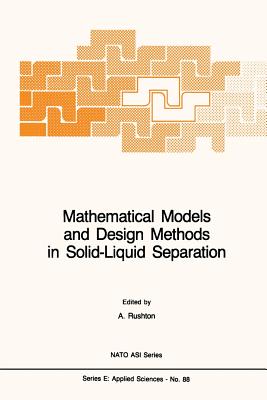
Mathematical Models and Design Methods in Solid-Liquid Separation
| PUBLISHER | Springer (11/03/2011) |
| PRODUCT TYPE | Paperback (Paperback) |
Description
The separation of finely-divided solids from liquids constitutes an important stage in many industrial processes. Separation of mixtures ranging from highly concentrated slurries to slightly turbid liquids must be effected in circumstances where the solids, liquid or both phases may have value. Separations may be achieved by use of a membrane or filter medium which, positioned in the path of a flowing suspension, will allow passage of the fluid whilst retaining solids on the surface or within the medium. Alternatively the two phases may be separated by sedimentation processes involving gravitational or centrifugal force. In either mode, separation difficulties are sometimes experienced with the result that solid-liquid separation is often a bottleneck in commercial plants. Operational difficulties and plant failures are associated with the random nature of the particles being separated; variations in size, shape, states of aggregation, compressibility, etc., produce a wide range of problems. Plugging of the filter medium or the collapse of the solids under applied stress lead to slow flowrates of liquid. The colloidal nature of some precipitates makes separation by settling virtually impossible without the use of chemical agents to enhance the size of basic units and to reduce repulsive surface forces. Unit operations such as filtration, comminution, etc., involve a seemingly bewildering array of machines which makes plant selection a difficult step and reflects the uncer- tainties attaching to operations involving the solid )hase. Many types of pressure, vacuum and centrifugal filter are available.
Show More
Product Format
Product Details
ISBN-13:
9789401087513
ISBN-10:
9401087512
Binding:
Paperback or Softback (Trade Paperback (Us))
Content Language:
English
More Product Details
Page Count:
399
Carton Quantity:
20
Product Dimensions:
6.14 x 0.84 x 9.21 inches
Weight:
1.27 pound(s)
Country of Origin:
NL
Subject Information
BISAC Categories
Technology & Engineering | Chemical & Biochemical
Technology & Engineering | Chemistry - Industrial & Technical
Technology & Engineering | Mechanical
Dewey Decimal:
660.284
Descriptions, Reviews, Etc.
publisher marketing
The separation of finely-divided solids from liquids constitutes an important stage in many industrial processes. Separation of mixtures ranging from highly concentrated slurries to slightly turbid liquids must be effected in circumstances where the solids, liquid or both phases may have value. Separations may be achieved by use of a membrane or filter medium which, positioned in the path of a flowing suspension, will allow passage of the fluid whilst retaining solids on the surface or within the medium. Alternatively the two phases may be separated by sedimentation processes involving gravitational or centrifugal force. In either mode, separation difficulties are sometimes experienced with the result that solid-liquid separation is often a bottleneck in commercial plants. Operational difficulties and plant failures are associated with the random nature of the particles being separated; variations in size, shape, states of aggregation, compressibility, etc., produce a wide range of problems. Plugging of the filter medium or the collapse of the solids under applied stress lead to slow flowrates of liquid. The colloidal nature of some precipitates makes separation by settling virtually impossible without the use of chemical agents to enhance the size of basic units and to reduce repulsive surface forces. Unit operations such as filtration, comminution, etc., involve a seemingly bewildering array of machines which makes plant selection a difficult step and reflects the uncer- tainties attaching to operations involving the solid )hase. Many types of pressure, vacuum and centrifugal filter are available.
Show More
List Price $219.99
Your Price
$217.79