
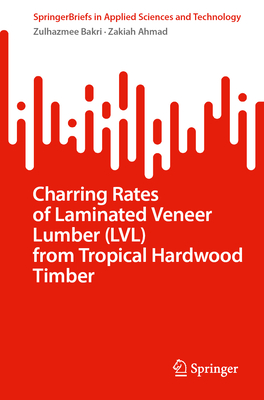
Charring Rates of Laminated Veneer Lumber (LVL) from Tropical Hardwood Timber
| AUTHOR | Bakri, Zulhazmee; Ahmad, Zakiah |
| PUBLISHER | Springer (07/03/2025) |
| PRODUCT TYPE | Paperback (Paperback) |
Description
This book highlights the charring rate performance of LVL made from tropical hardwood according to EN 13381-7 and BS 476 standards. Laminated Veneer Lumber (LVL) is produced by bonding layers of wood veneers using adhesives, heat, and pressure, resulting in products that are typically stronger, more dimensionally stable, and more resistant to environmental factors than solid timber. This makes LVL highly versatile for use in structural components of buildings. However, there remains limited knowledge about how LVL, particularly those made from tropical hardwood, performs under fire exposure. Understanding the charring process, where the outer wood layers degrade and form a protective char layer insulating the core helps engineers estimate the load-bearing capacity of LVL during a fire. Experimental studies and predictive models are discussed to provide insights into charring behavior under different conditions. The findings contribute to enhancing fire safety design in timber construction, ensuring compliance with international standards and improving the resilience of timber buildings during fire scenarios.
Show More
Product Format
Product Details
ISBN-13:
9789819658367
ISBN-10:
9819658365
Binding:
Paperback or Softback (Trade Paperback (Us))
Content Language:
English
More Product Details
Page Count:
96
Carton Quantity:
0
Product Dimensions:
5.90 x 0.30 x 8.90 inches
Weight:
0.45 pound(s)
Country of Origin:
NL
Subject Information
BISAC Categories
Technology & Engineering | Fire Science
Technology & Engineering | Civil - General
Technology & Engineering | Materials Science - General
Descriptions, Reviews, Etc.
publisher marketing
This book highlights the charring rate performance of LVL made from tropical hardwood according to EN 13381-7 and BS 476 standards. Laminated Veneer Lumber (LVL) is produced by bonding layers of wood veneers using adhesives, heat, and pressure, resulting in products that are typically stronger, more dimensionally stable, and more resistant to environmental factors than solid timber. This makes LVL highly versatile for use in structural components of buildings. However, there remains limited knowledge about how LVL, particularly those made from tropical hardwood, performs under fire exposure. Understanding the charring process, where the outer wood layers degrade and form a protective char layer insulating the core helps engineers estimate the load-bearing capacity of LVL during a fire. Experimental studies and predictive models are discussed to provide insights into charring behavior under different conditions. The findings contribute to enhancing fire safety design in timber construction, ensuring compliance with international standards and improving the resilience of timber buildings during fire scenarios.
Show More
List Price $54.99
Your Price
$54.44