
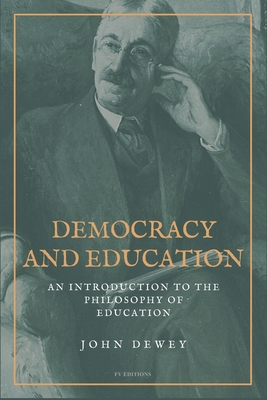
Democracy and Education: An Introduction to the Philosophy of Education (Easy to Read Layout)
| AUTHOR | Dewey, John |
| PUBLISHER | Fv Editions (01/01/2023) |
| PRODUCT TYPE | Paperback (Paperback) (LARGE PRINT) |
"Education is thus a fostering, a nurturing, a cultivating, process. All of these words mean that it implies attention to the conditions of growth"
The following pages embody an endeavor to detect and state the ideas implied in a democratic society and to apply these ideas to the problems of the enterprise of education. The discussion includes an indication of the constructive aims and methods of public education as seen from this point of view, and a critical estimate of the theories of knowing and moral development which were formulated in earlier social conditions, but which still operate, in societies nominally democratic, to hamper the adequate realization of the democratic ideal. As will appear from the book itself, the philosophy stated in this book connects the growth of democracy with the development of the experimental method in the sciences, evolutionary ideas in the biological sciences, and the industrial reorganization, and is concerned to point out the changes in subject matter and method of education indicated by these developments.
John Dewey was an American philosopher, psychologist, and educational reformer whose ideas have been influential in education and social reform. He was one of the most prominent American scholars in the first half of the twentieth century.
This Premium Edition comes with an Easy to Read Layout making reading comfortable.
"Education is thus a fostering, a nurturing, a cultivating, process. All of these words mean that it implies attention to the conditions of growth"
The following pages embody an endeavor to detect and state the ideas implied in a democratic society and to apply these ideas to the problems of the enterprise of education. The discussion includes an indication of the constructive aims and methods of public education as seen from this point of view, and a critical estimate of the theories of knowing and moral development which were formulated in earlier social conditions, but which still operate, in societies nominally democratic, to hamper the adequate realization of the democratic ideal. As will appear from the book itself, the philosophy stated in this book connects the growth of democracy with the development of the experimental method in the sciences, evolutionary ideas in the biological sciences, and the industrial reorganization, and is concerned to point out the changes in subject matter and method of education indicated by these developments.
John Dewey was an American philosopher, psychologist, and educational reformer whose ideas have been influential in education and social reform. He was one of the most prominent American scholars in the first half of the twentieth century.
This Premium Edition comes with an Easy to Read Layout making reading comfortable.