
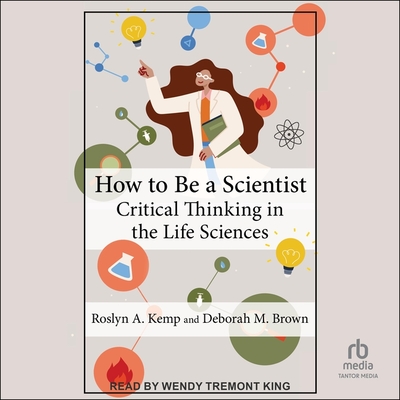
How to Be a Scientist: Critical Thinking in the Life Sciences
| AUTHOR | Kemp, Roslyn A.; King, Wendy Tremont; Brown, Deborah M. |
| PUBLISHER | Tantor Audio (09/17/2024) |
| PRODUCT TYPE | Audio (MP3 CD) |
Description
Many undergraduate students choose a science degree but are not aware of how science and research work in the real world. This book explains how scientific research is conceived, carried out and analyzed. It outlines how research findings are constantly evolving and why that is exciting and important. Students using this textbook will learn how to design experiments, explain their data, and analyze and interpret the work of others. They will learn to think about broader aspects of science, such as bias and ethics. They will gain practical skills, including understanding the use of statistical tests and how to prepare an effective presentation. Active individual and class exercises provide opportunities for students to think about difficult concepts in science and research and to include their own perspectives. Key Features: ? Encourages discussion and critical thinking using individual and class exercises ? Provides real-world examples and context for difficult concepts ? Documents a variety of career options and opportunities from studying science ? Permits students to advocate for science with suggestions for creating and sharing research
Show More
Product Format
Product Details
ISBN-13:
9798228010833
Binding:
CD-Audio (MP3 Format)
Content Language:
English
More Product Details
Carton Quantity:
100
Feature Codes:
Unabridged
Country of Origin:
US
Subject Information
BISAC Categories
Science | Life Sciences - Biology
Science | Life Sciences - Cell Biology
Descriptions, Reviews, Etc.
publisher marketing
Many undergraduate students choose a science degree but are not aware of how science and research work in the real world. This book explains how scientific research is conceived, carried out and analyzed. It outlines how research findings are constantly evolving and why that is exciting and important. Students using this textbook will learn how to design experiments, explain their data, and analyze and interpret the work of others. They will learn to think about broader aspects of science, such as bias and ethics. They will gain practical skills, including understanding the use of statistical tests and how to prepare an effective presentation. Active individual and class exercises provide opportunities for students to think about difficult concepts in science and research and to include their own perspectives. Key Features: ? Encourages discussion and critical thinking using individual and class exercises ? Provides real-world examples and context for difficult concepts ? Documents a variety of career options and opportunities from studying science ? Permits students to advocate for science with suggestions for creating and sharing research
Show More
List Price $45.95
Your Price
$45.49