
Available options are listed below:
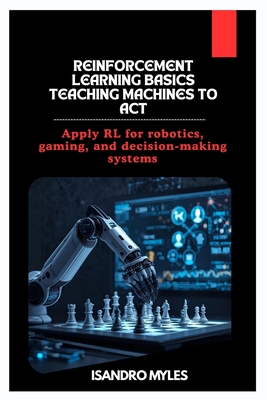
Reinforcement Learning Basics Teaching Machines to Act: Apply RL for robotics, gaming, and decision-making systems
| AUTHOR | Myles, Isandro |
| PUBLISHER | Independently Published (09/10/2025) |
| PRODUCT TYPE | Paperback (Paperback) |
Unlock the power of Reinforcement Learning to make machines that learn by doing.
Reinforcement Learning Basics is your hands-on guide to building intelligent systems that learn from experience, adapt to dynamic environments, and make decisions autonomously. From robotics and gaming to real-world decision-making, this book equips beginners and intermediate developers with the skills to implement RL algorithms effectively using practical examples.
Inside, you'll learn how to:
Understand core RL concepts: agents, environments, states, actions, rewards, and policies.
Implement classic RL algorithms such as Q-Learning, SARSA, and Monte Carlo methods.
Explore deep reinforcement learning techniques with neural networks for complex environments.
Apply policy gradient methods and actor-critic models to optimize decision-making.
Train autonomous agents in simulated environments using Python and popular RL libraries.
Utilize reward shaping and exploration strategies to accelerate learning.
Integrate RL into robotics applications for navigation, manipulation, and adaptive control.
Develop gaming AI agents that adapt, compete, and improve over time.
Build decision-making systems for finance, logistics, and operations using RL frameworks.
Evaluate and fine-tune RL models with metrics to ensure optimal performance.
Packed with hands-on projects, step-by-step tutorials, and real-world examples, this book gives you the foundation to create autonomous, learning systems that can tackle dynamic, uncertain environments confidently.
Who This Book Is ForAspiring AI developers wanting to explore reinforcement learning
Robotics enthusiasts seeking autonomous control solutions
Game developers looking to build intelligent, adaptive AI agents
Students, researchers, and professionals interested in applied RL for decision-making
Learn the fundamentals of Reinforcement Learning and start building intelligent systems that act, adapt, and improve on their own.
Unlock the power of Reinforcement Learning to make machines that learn by doing.
Reinforcement Learning Basics is your hands-on guide to building intelligent systems that learn from experience, adapt to dynamic environments, and make decisions autonomously. From robotics and gaming to real-world decision-making, this book equips beginners and intermediate developers with the skills to implement RL algorithms effectively using practical examples.
Inside, you'll learn how to:
Understand core RL concepts: agents, environments, states, actions, rewards, and policies.
Implement classic RL algorithms such as Q-Learning, SARSA, and Monte Carlo methods.
Explore deep reinforcement learning techniques with neural networks for complex environments.
Apply policy gradient methods and actor-critic models to optimize decision-making.
Train autonomous agents in simulated environments using Python and popular RL libraries.
Utilize reward shaping and exploration strategies to accelerate learning.
Integrate RL into robotics applications for navigation, manipulation, and adaptive control.
Develop gaming AI agents that adapt, compete, and improve over time.
Build decision-making systems for finance, logistics, and operations using RL frameworks.
Evaluate and fine-tune RL models with metrics to ensure optimal performance.
Packed with hands-on projects, step-by-step tutorials, and real-world examples, this book gives you the foundation to create autonomous, learning systems that can tackle dynamic, uncertain environments confidently.
Who This Book Is ForAspiring AI developers wanting to explore reinforcement learning
Robotics enthusiasts seeking autonomous control solutions
Game developers looking to build intelligent, adaptive AI agents
Students, researchers, and professionals interested in applied RL for decision-making
Learn the fundamentals of Reinforcement Learning and start building intelligent systems that act, adapt, and improve on their own.