
Available options are listed below:
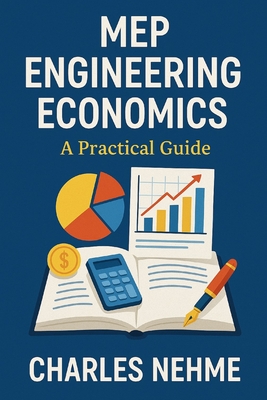
MEP Engineering Economics: A Practical Guide
| AUTHOR | Nehme, Charles |
| PUBLISHER | Independently Published (07/31/2025) |
| PRODUCT TYPE | Paperback (Paperback) |
In today's rapidly evolving built environment, the demand for sustainable, efficient, and cost-effective building systems has never been greater. Mechanical, Electrical, and Plumbing (MEP) systems are the lifeblood of any modern structure, dictating everything from indoor air quality and occupant comfort to energy consumption and operational longevity. Yet, the true value of these intricate systems often extends far beyond their initial installation cost. It lies in their long-term economic performance, their impact on the environment, and their contribution to the overall resilience and functionality of a building.
This book, "MEP Engineering Economics: A Practical Guide," is born from the recognition that sound economic analysis is not merely an optional add-on but a fundamental pillar of successful MEP engineering. It aims to equip engineers, consultants, project managers, and students with the essential tools and methodologies to make informed, financially astute decisions throughout the entire lifecycle of MEP projects. We will delve into the core principles of engineering economics, demonstrating how to apply them to real-world scenarios, from evaluating competing system designs to justifying investments in energy efficiency and understanding the total cost of ownership.
The insights within these pages are distilled from decades of practical experience across diverse international markets and a deep commitment to optimizing built environments. My hope is that this guide will serve as an invaluable resource, empowering you to not only design and implement superior MEP systems but also to articulate their economic benefits with clarity and confidence, ultimately contributing to more sustainable and economically viable projects worldwide.
In today's rapidly evolving built environment, the demand for sustainable, efficient, and cost-effective building systems has never been greater. Mechanical, Electrical, and Plumbing (MEP) systems are the lifeblood of any modern structure, dictating everything from indoor air quality and occupant comfort to energy consumption and operational longevity. Yet, the true value of these intricate systems often extends far beyond their initial installation cost. It lies in their long-term economic performance, their impact on the environment, and their contribution to the overall resilience and functionality of a building.
This book, "MEP Engineering Economics: A Practical Guide," is born from the recognition that sound economic analysis is not merely an optional add-on but a fundamental pillar of successful MEP engineering. It aims to equip engineers, consultants, project managers, and students with the essential tools and methodologies to make informed, financially astute decisions throughout the entire lifecycle of MEP projects. We will delve into the core principles of engineering economics, demonstrating how to apply them to real-world scenarios, from evaluating competing system designs to justifying investments in energy efficiency and understanding the total cost of ownership.
The insights within these pages are distilled from decades of practical experience across diverse international markets and a deep commitment to optimizing built environments. My hope is that this guide will serve as an invaluable resource, empowering you to not only design and implement superior MEP systems but also to articulate their economic benefits with clarity and confidence, ultimately contributing to more sustainable and economically viable projects worldwide.