
Available options are listed below:
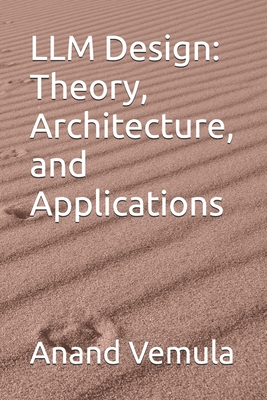
LLM Design: Theory, Architecture, and Applications
| AUTHOR | Vemula, Anand |
| PUBLISHER | Independently Published (05/31/2024) |
| PRODUCT TYPE | Paperback (Paperback) |
"LLM Design: Theory, Architecture, and Applications" is a comprehensive guide that delves into the intricate world of Large Language Models (LLMs), exploring their theoretical foundations, architectural components, and diverse applications. From understanding the fundamental concepts behind language models to implementing them in real-world scenarios, this book serves as an essential resource for researchers, developers, and enthusiasts in the field of artificial intelligence and natural language processing.
The book begins by elucidating the theoretical underpinnings of LLMs, discussing key concepts such as language modeling, neural network basics, and the theoretical foundations that drive their development. It then delves into the architectural aspects, covering transformer-based models, variants of transformer architectures, and techniques for handling multilingual data. Readers will gain insights into the training process, including data collection, preprocessing, tokenization, and various training techniques like supervised and unsupervised learning, transfer learning, and fine-tuning.
Furthermore, "LLM Design" explores scalability aspects, discussing scaling laws, model parallelism, and data parallelism, essential for training and deploying large-scale language models efficiently. The book also addresses critical topics related to safety, ethics, and model interpretability, emphasizing the importance of fairness, bias mitigation, and transparency in LLM deployment.
In the applications and deployment section, readers are introduced to a myriad of NLP applications, including text generation, translation, summarization, and question answering. The deployment strategies discussed cover model serving, API design, and real-time inference, essential for integrating LLMs into diverse applications. Additionally, the book offers insights into maintenance and updates, addressing model monitoring, continuous improvement, and handling model drift to ensure long-term model effectiveness.
With its comprehensive coverage of LLM design principles, architectures, and practical applications, "LLM Design: Theory, Architecture, and Applications" is an indispensable guide for anyone seeking to understand and harness the power of large language models in today's AI-driven world.
"LLM Design: Theory, Architecture, and Applications" is a comprehensive guide that delves into the intricate world of Large Language Models (LLMs), exploring their theoretical foundations, architectural components, and diverse applications. From understanding the fundamental concepts behind language models to implementing them in real-world scenarios, this book serves as an essential resource for researchers, developers, and enthusiasts in the field of artificial intelligence and natural language processing.
The book begins by elucidating the theoretical underpinnings of LLMs, discussing key concepts such as language modeling, neural network basics, and the theoretical foundations that drive their development. It then delves into the architectural aspects, covering transformer-based models, variants of transformer architectures, and techniques for handling multilingual data. Readers will gain insights into the training process, including data collection, preprocessing, tokenization, and various training techniques like supervised and unsupervised learning, transfer learning, and fine-tuning.
Furthermore, "LLM Design" explores scalability aspects, discussing scaling laws, model parallelism, and data parallelism, essential for training and deploying large-scale language models efficiently. The book also addresses critical topics related to safety, ethics, and model interpretability, emphasizing the importance of fairness, bias mitigation, and transparency in LLM deployment.
In the applications and deployment section, readers are introduced to a myriad of NLP applications, including text generation, translation, summarization, and question answering. The deployment strategies discussed cover model serving, API design, and real-time inference, essential for integrating LLMs into diverse applications. Additionally, the book offers insights into maintenance and updates, addressing model monitoring, continuous improvement, and handling model drift to ensure long-term model effectiveness.
With its comprehensive coverage of LLM design principles, architectures, and practical applications, "LLM Design: Theory, Architecture, and Applications" is an indispensable guide for anyone seeking to understand and harness the power of large language models in today's AI-driven world.