
ISBN 9798624631564 is currently unpriced. Please contact us for pricing.
Available options are listed below:
Available options are listed below:
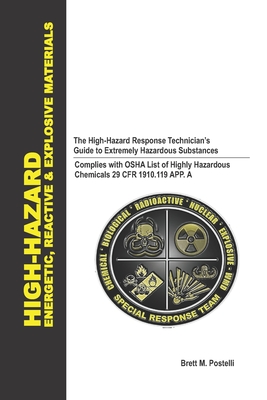
High-Hazard - Energetic, Reactive & Explosive Materials: The High-Hazard Response Technician's Guide to Extremely Hazardous Substances
| AUTHOR | Postelli, Brett M. |
| PUBLISHER | Independently Published (03/14/2020) |
| PRODUCT TYPE | Paperback (Paperback) |
Description
This handbook was created with the intent to provide High-Hazard Response Technicians (HHRT) with basic chemistry based hazardous substance information that may not be found in one particular location e.g. common chemistry terms and definitions, understanding the atomic structure, hydrocarbons, chemical compounds, elements of the periodic table, and the NIOSH chemical/physical properties, and stability/reactivity reference information. It is very important to understand this handbook provides multiple forms of reference material, additional advanced and technical reference material (e.g. Bretherick's Handbook of Reactive Chemicals, Oxford Chemical Dictionary, etc.) will need to be obtained according to the reader's needs, nonetheless, the material used throughout this handbook will assist the technician when potentially handling or encountering Extremely Hazardous Substances (EHS) by using the quick reference Guide to Chemical Hazards, Incompatibilities & Reactive section of the handbook. Personnel who specialize in the handling of these materials must have an understanding of the chemistry of EHS in order to choose the proper personal protective equipment (PPE), containment vessels, collection procedures, neutralization tactics, disposal methods, handling, packing, marking, storage, and shipment of energetic materials per 1910.109 OSHA. ***** This handbook is NOT a chemistry dictionary or instructional textbook nor is it intended to be. It simply provides fundamental chemistry information that hazmat and hazardous waste workers may encounter and need to have a better understanding of, such as: OSHA regulations, organic chemistry vs. inorganic chemistry, atomic structures, terms and definitions, types of bonding, naming of compounds, balancing chemical equations, elements of the periodic table, how reaction formulas work, sampling/detection devices, and incompatible, reactive and energetic materials.
Show More
Product Format
Product Details
ISBN-13:
9798624631564
Binding:
Paperback or Softback (Trade Paperback (Us))
Content Language:
English
More Product Details
Page Count:
662
Carton Quantity:
12
Product Dimensions:
6.00 x 1.33 x 9.00 inches
Weight:
1.92 pound(s)
Country of Origin:
US
Subject Information
BISAC Categories
Science | Environmental Science (see also Chemistry - Environmental)
Descriptions, Reviews, Etc.
publisher marketing
This handbook was created with the intent to provide High-Hazard Response Technicians (HHRT) with basic chemistry based hazardous substance information that may not be found in one particular location e.g. common chemistry terms and definitions, understanding the atomic structure, hydrocarbons, chemical compounds, elements of the periodic table, and the NIOSH chemical/physical properties, and stability/reactivity reference information. It is very important to understand this handbook provides multiple forms of reference material, additional advanced and technical reference material (e.g. Bretherick's Handbook of Reactive Chemicals, Oxford Chemical Dictionary, etc.) will need to be obtained according to the reader's needs, nonetheless, the material used throughout this handbook will assist the technician when potentially handling or encountering Extremely Hazardous Substances (EHS) by using the quick reference Guide to Chemical Hazards, Incompatibilities & Reactive section of the handbook. Personnel who specialize in the handling of these materials must have an understanding of the chemistry of EHS in order to choose the proper personal protective equipment (PPE), containment vessels, collection procedures, neutralization tactics, disposal methods, handling, packing, marking, storage, and shipment of energetic materials per 1910.109 OSHA. ***** This handbook is NOT a chemistry dictionary or instructional textbook nor is it intended to be. It simply provides fundamental chemistry information that hazmat and hazardous waste workers may encounter and need to have a better understanding of, such as: OSHA regulations, organic chemistry vs. inorganic chemistry, atomic structures, terms and definitions, types of bonding, naming of compounds, balancing chemical equations, elements of the periodic table, how reaction formulas work, sampling/detection devices, and incompatible, reactive and energetic materials.
Show More