
ISBN 9798884848450 is currently unpriced. Please contact us for pricing.
Available options are listed below:
Available options are listed below:
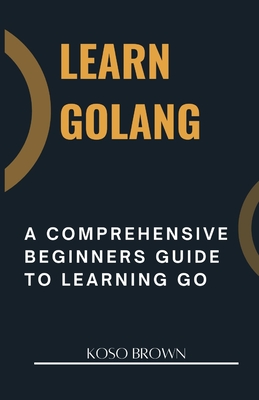
Learn Golang: A Comprehensive Beginners Guide to Learning Go
| AUTHOR | Brown, Koso |
| PUBLISHER | Independently Published (03/14/2024) |
| PRODUCT TYPE | Paperback (Paperback) |
Description
Google's Go programming language, which has been available for more than a decade, has changed from being a curiosity for tech enthusiasts to the robust programming language used in some of the most significant cloud-native software projects worldwide.
Although Go, also known as Golang, was developed by Google staff members, primarily Rob Pike, a notable engineer at Google and a veteran Unix expert, it is not officially a "Google project." Instead, Go is an open-source project that is being developed by the community, with strong leadership guiding the language's future direction and how it should be utilized.
Go is designed to be easy to use, simple to learn, and easy for other developers to read. Go's feature set is somewhat small, especially in comparison to other programming languages like C++. Because of its syntax, which is similar to that of C, Go is relatively simple for experienced C developers to understand. Nevertheless, a lot of Go's features-particularly its functional programming and concurrency features-are reminiscent of Erlang and other older languages.
Go shares many similarities with Java as a C-like language for creating and managing cross-platform enterprise applications of various kinds. You might also compare Go and Python to facilitate the quick construction of code that might execute anywhere, but the distinctions between the two languages are much more than the similarities. " quick, statically typed, compiled language that feels like a dynamically typed, interpreted language" is how the Go documentation characterizes Go. Even a big Go program can be compiled in a few seconds. Additionally, Go does not have as much overhead as C-style includes files and libraries.
Although Go, also known as Golang, was developed by Google staff members, primarily Rob Pike, a notable engineer at Google and a veteran Unix expert, it is not officially a "Google project." Instead, Go is an open-source project that is being developed by the community, with strong leadership guiding the language's future direction and how it should be utilized.
Go is designed to be easy to use, simple to learn, and easy for other developers to read. Go's feature set is somewhat small, especially in comparison to other programming languages like C++. Because of its syntax, which is similar to that of C, Go is relatively simple for experienced C developers to understand. Nevertheless, a lot of Go's features-particularly its functional programming and concurrency features-are reminiscent of Erlang and other older languages.
Go shares many similarities with Java as a C-like language for creating and managing cross-platform enterprise applications of various kinds. You might also compare Go and Python to facilitate the quick construction of code that might execute anywhere, but the distinctions between the two languages are much more than the similarities. " quick, statically typed, compiled language that feels like a dynamically typed, interpreted language" is how the Go documentation characterizes Go. Even a big Go program can be compiled in a few seconds. Additionally, Go does not have as much overhead as C-style includes files and libraries.
Show More
Product Format
Product Details
ISBN-13:
9798884848450
Binding:
Paperback or Softback (Trade Paperback (Us))
Content Language:
English
More Product Details
Page Count:
44
Carton Quantity:
186
Product Dimensions:
5.50 x 0.09 x 8.50 inches
Weight:
0.14 pound(s)
Country of Origin:
US
Subject Information
BISAC Categories
Computers | Computer Science
Descriptions, Reviews, Etc.
publisher marketing
Google's Go programming language, which has been available for more than a decade, has changed from being a curiosity for tech enthusiasts to the robust programming language used in some of the most significant cloud-native software projects worldwide.
Although Go, also known as Golang, was developed by Google staff members, primarily Rob Pike, a notable engineer at Google and a veteran Unix expert, it is not officially a "Google project." Instead, Go is an open-source project that is being developed by the community, with strong leadership guiding the language's future direction and how it should be utilized.
Go is designed to be easy to use, simple to learn, and easy for other developers to read. Go's feature set is somewhat small, especially in comparison to other programming languages like C++. Because of its syntax, which is similar to that of C, Go is relatively simple for experienced C developers to understand. Nevertheless, a lot of Go's features-particularly its functional programming and concurrency features-are reminiscent of Erlang and other older languages.
Go shares many similarities with Java as a C-like language for creating and managing cross-platform enterprise applications of various kinds. You might also compare Go and Python to facilitate the quick construction of code that might execute anywhere, but the distinctions between the two languages are much more than the similarities. " quick, statically typed, compiled language that feels like a dynamically typed, interpreted language" is how the Go documentation characterizes Go. Even a big Go program can be compiled in a few seconds. Additionally, Go does not have as much overhead as C-style includes files and libraries.
Although Go, also known as Golang, was developed by Google staff members, primarily Rob Pike, a notable engineer at Google and a veteran Unix expert, it is not officially a "Google project." Instead, Go is an open-source project that is being developed by the community, with strong leadership guiding the language's future direction and how it should be utilized.
Go is designed to be easy to use, simple to learn, and easy for other developers to read. Go's feature set is somewhat small, especially in comparison to other programming languages like C++. Because of its syntax, which is similar to that of C, Go is relatively simple for experienced C developers to understand. Nevertheless, a lot of Go's features-particularly its functional programming and concurrency features-are reminiscent of Erlang and other older languages.
Go shares many similarities with Java as a C-like language for creating and managing cross-platform enterprise applications of various kinds. You might also compare Go and Python to facilitate the quick construction of code that might execute anywhere, but the distinctions between the two languages are much more than the similarities. " quick, statically typed, compiled language that feels like a dynamically typed, interpreted language" is how the Go documentation characterizes Go. Even a big Go program can be compiled in a few seconds. Additionally, Go does not have as much overhead as C-style includes files and libraries.
Show More