
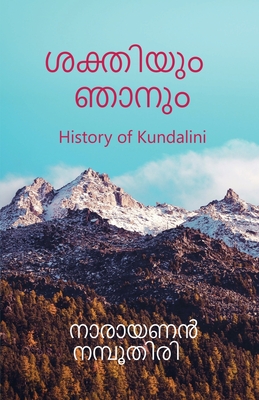
Sakthiyum Njanum: History of Kundalini
| AUTHOR | Narayanan Namboodiri |
| PUBLISHER | Notion Press (09/08/2025) |
| PRODUCT TYPE | Paperback (Paperback) |
Shakthiyum Njanum: A History of Kundalini
This is the most authentic and comprehensive book on the great power known as 'Kundalini', which lies dormant like a fiery serpent within the human body. A follow-up to the author's acclaimed book 'Shivanum Njanum' (Shiva and I), 'Shakthiyum Njanum' (Shakti and I) presents profound subjects in a simple and accessible language.
The book lucidly explains the journey of this concept, starting from the Mother Goddess worship in the Indus Valley millennia ago, and tracing its evolution through the Vedas, Upanishads, and Yogic-Tantric philosophies. While unraveling the mysterious Kundalini concepts in traditions like Kashmiri Shaivism, Srividya, and Kerala Tantra, the author also details how Western and modern thinkers-from Arthur Avalon and Gopi Krishnan to Carl Jung, Itzhak Bentov, Andrew Newberg, and Anodea Judith-viewed this great phenomenon.
Building a bridge between ancient beliefs and modern scientific studies, this work is an asset for anyone wishing to understand the enigma of Kundalini at every level. It promises a deep reading experience for spiritual seekers, yoga students, those interested in Indian philosophies, and anyone curious about the paths where science and spirituality converge.
Shakthiyum Njanum: A History of Kundalini
This is the most authentic and comprehensive book on the great power known as 'Kundalini', which lies dormant like a fiery serpent within the human body. A follow-up to the author's acclaimed book 'Shivanum Njanum' (Shiva and I), 'Shakthiyum Njanum' (Shakti and I) presents profound subjects in a simple and accessible language.
The book lucidly explains the journey of this concept, starting from the Mother Goddess worship in the Indus Valley millennia ago, and tracing its evolution through the Vedas, Upanishads, and Yogic-Tantric philosophies. While unraveling the mysterious Kundalini concepts in traditions like Kashmiri Shaivism, Srividya, and Kerala Tantra, the author also details how Western and modern thinkers-from Arthur Avalon and Gopi Krishnan to Carl Jung, Itzhak Bentov, Andrew Newberg, and Anodea Judith-viewed this great phenomenon.
Building a bridge between ancient beliefs and modern scientific studies, this work is an asset for anyone wishing to understand the enigma of Kundalini at every level. It promises a deep reading experience for spiritual seekers, yoga students, those interested in Indian philosophies, and anyone curious about the paths where science and spirituality converge.