
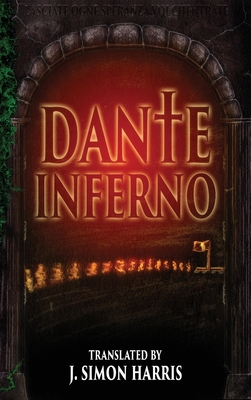
Inferno
| AUTHOR | Harris, J. Simon; Alighieri, Dante |
| PUBLISHER | Nostra Vita Books (04/07/2022) |
| PRODUCT TYPE | Hardcover (Hardcover) |
Journey with Dante into the bowels of the earth and the profoundest depths of the human soul. The Inferno, the first part of Dante's Divine Comedy, has captivated readers for over seven centuries. This modern translation in terza rima captures the true essence of the Italian poem.
This edition also includes:
Notes: A single page of commentary for each canto, providing enough context for the modern reader to follow Dante's historical references and literary allusions, without getting bogged down by excessive notes. More extensive notes can be found, at no additional cost, on the book's companion website (Dante's Afterlife).
Bibliography and Further Reading: A detailed list of relevant primary and secondary sources (including online and multimedia resources), with short descriptions of each.
Glossary: Concise descriptions and phonetic pronunciation guides for every person and place in the book. For each time a person or place is mentioned in the text, a canto and line number is provided in the glossary. It's easy to look up someone you're unfamiliar with, and it's equally easy to see where Dante refers to them in the text (even if they're unnamed).
Illustrations, Maps, and Diagrams: Over a dozen original images and diagrams created by the translator, including a map of medieval Florence, a map of Tuscany and northern Italy, maps of Dante's Hell, a zodiac showing the positions of the planets at the start of Dante's journey, a timeline and schematic of the journey, and more.
Dante's Afterlife: For readers and students of Dante who want to explore beyond the confines of the book, J. Simon Harris has created a companion website called Dante's Afterlife (a QR code and url are found at the back of the book). Here, the translator will publish extended commentary on the poem, historical background (a history of the Guelphs and Ghibellines, and the life of Dante), unique images, brief essays, translations of Dante's lyric poems and those of his contemporaries, and more. The website will be added to continually, and it will always remain free of charge.
Journey with Dante into the bowels of the earth and the profoundest depths of the human soul. The Inferno, the first part of Dante's Divine Comedy, has captivated readers for over seven centuries. This modern translation in terza rima captures the true essence of the Italian poem.
This edition also includes:
Notes: A single page of commentary for each canto, providing enough context for the modern reader to follow Dante's historical references and literary allusions, without getting bogged down by excessive notes. More extensive notes can be found, at no additional cost, on the book's companion website (Dante's Afterlife).
Bibliography and Further Reading: A detailed list of relevant primary and secondary sources (including online and multimedia resources), with short descriptions of each.
Glossary: Concise descriptions and phonetic pronunciation guides for every person and place in the book. For each time a person or place is mentioned in the text, a canto and line number is provided in the glossary. It's easy to look up someone you're unfamiliar with, and it's equally easy to see where Dante refers to them in the text (even if they're unnamed).
Illustrations, Maps, and Diagrams: Over a dozen original images and diagrams created by the translator, including a map of medieval Florence, a map of Tuscany and northern Italy, maps of Dante's Hell, a zodiac showing the positions of the planets at the start of Dante's journey, a timeline and schematic of the journey, and more.
Dante's Afterlife: For readers and students of Dante who want to explore beyond the confines of the book, J. Simon Harris has created a companion website called Dante's Afterlife (a QR code and url are found at the back of the book). Here, the translator will publish extended commentary on the poem, historical background (a history of the Guelphs and Ghibellines, and the life of Dante), unique images, brief essays, translations of Dante's lyric poems and those of his contemporaries, and more. The website will be added to continually, and it will always remain free of charge.
A native of Florence, Dante was deeply involved in his city-state s politics and had political, as well as poetic, ambitions. He was exiled from Florence in 1301 for backing the losing faction in a dispute over the pope s influence, and never saw Florence again.
While in exile, Dante wrote the Comedy, the tale of the poet s pilgrimage through Hell, Purgatory, and Paradise. To reach the largest possible audience for the work, Dante devised a version of Italian based largely on his own Tuscan dialect and incorporating Latin and parts of other regional dialects. In so doing, he demonstrated the vernacular s fitness for artistic expression, and earned the title Father of the Italian language.
Dante died in Ravenna in 1321, and his body remains there despite the fact that Florence erected a tomb for him in 1829.