
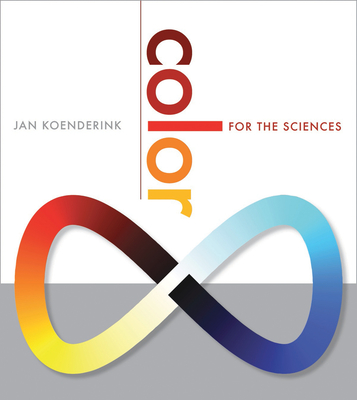
Color for the Sciences
| AUTHOR | Koenderink, Jan J.; Koenderink, Jan J. |
| PUBLISHER | MIT Press (08/20/2010) |
| PRODUCT TYPE | Hardcover (Hardcover) |
A comprehensive introduction to colorimetry from a conceptual perspective.
Color for the Sciences is the first book on colorimetry to offer an account that emphasizes conceptual and formal issues rather than applications. Jan Koenderink's introductory text treats colorimetry--literally, "color measurement"--as a science, freeing the topic from the usual fixation on conventional praxis and how to get the "right" result. Readers of Color for the Sciences will learn to rethink concepts from the roots in order to reach a broader, conceptual understanding.
After a brief account of the history of the discipline (beginning with Isaac Newton) and a chapter titled "Colorimetry for Dummies," the heart of the book covers the main topics in colorimetry, including the space of beams, achromatic beams, edge colors, optimum colors, color atlases, and spectra. Other chapters cover more specialized topics, including implementations, metrics pioneered by Schr dinger and Helmholtz, and extended color space.
Color for the Sciences can be used as a reference for professionals or in a formal introductory course on colorimetry. It will be especially useful both for those working with color in a scientific or engineering context who find the standard texts lacking and for professionals and students in image engineering, computer graphics, and computer science. Each chapter ends with exercises, many of which are open-ended, suggesting ways to explore the topic further, and can be developed into research projects. The text and notes contain numerous suggestions for demonstration experiments and individual explorations. The book is self-contained, with formal methods explained in appendixes when necessary.
A comprehensive introduction to colorimetry from a conceptual perspective.
Color for the Sciences is the first book on colorimetry to offer an account that emphasizes conceptual and formal issues rather than applications. Jan Koenderink's introductory text treats colorimetry--literally, "color measurement"--as a science, freeing the topic from the usual fixation on conventional praxis and how to get the "right" result. Readers of Color for the Sciences will learn to rethink concepts from the roots in order to reach a broader, conceptual understanding.
After a brief account of the history of the discipline (beginning with Isaac Newton) and a chapter titled "Colorimetry for Dummies," the heart of the book covers the main topics in colorimetry, including the space of beams, achromatic beams, edge colors, optimum colors, color atlases, and spectra. Other chapters cover more specialized topics, including implementations, metrics pioneered by Schr dinger and Helmholtz, and extended color space.
Color for the Sciences can be used as a reference for professionals or in a formal introductory course on colorimetry. It will be especially useful both for those working with color in a scientific or engineering context who find the standard texts lacking and for professionals and students in image engineering, computer graphics, and computer science. Each chapter ends with exercises, many of which are open-ended, suggesting ways to explore the topic further, and can be developed into research projects. The text and notes contain numerous suggestions for demonstration experiments and individual explorations. The book is self-contained, with formal methods explained in appendixes when necessary.