
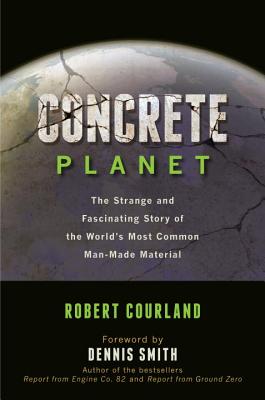
Concrete Planet: The Strange and Fascinating Story of the World's Most Common Man-Made Material
| AUTHOR | Courland, Robert; Smith, Dennis |
| PUBLISHER | Prometheus Books (11/22/2011) |
| PRODUCT TYPE | Hardcover (Hardcover) |
Description
Concrete: We use it for our buildings, bridges, dams, and roads. We walk on it, drive on it, and many of us live and work within its walls. But very few of us know what it is. We take for granted this ubiquitous substance, which both literally and figuratively comprises much of modern civilization's constructed environment; yet the story of its creation and development features a cast of fascinating characters and remarkable historical episodes. This book delves into this history, opening readers' eyes at every turn.In a lively narrative peppered with intriguing details, author Robert Corland describes how some of the most famous personalities of history became involved in the development and use of concrete-including King Herod the Great of Judea, the Roman emperor Hadrian, Thomas Edison (who once owned the largest concrete cement plant in the world), and architect Frank Lloyd Wright. Courland points to recent archaeological evidence suggesting that the discovery of concrete directly led to the Neolithic Revolution and the rise of the earliest civilizations. Much later, the Romans reached extraordinarily high standards for concrete production, showcasing their achievement in iconic buildings like the Coliseum and the Pantheon. Amazingly, with the fall of the Roman Empire, the secrets of concrete manufacturing were lost for over a millennium. The author explains that when concrete was rediscovered in the late eighteenth century it was initially viewed as an interesting novelty or, at best, a specialized building material suitable only for a narrow range of applications. It was only toward the end of the nineteenth century that the use of concrete exploded. During this rapid expansion, industry lobbyists tried to disguise the fact that modern concrete had certain defects and critical shortcomings. It is now recognized that modern concrete, unlike its Roman predecessor, gradually disintegrates with age. Compounding this problem is another distressing fact: the manufacture of concrete cement is a major contributor to global warming. Concrete Planet is filled with incredible stories, fascinating characters, surprising facts, and an array of intriguing insights into the building material that forms the basis of the infrastructure on which we depend.
Show More
Product Format
Product Details
ISBN-13:
9781616144814
ISBN-10:
1616144815
Binding:
Hardback or Cased Book (Sewn)
Content Language:
English
More Product Details
Page Count:
396
Carton Quantity:
4
Product Dimensions:
6.27 x 1.12 x 9.21 inches
Weight:
1.48 pound(s)
Feature Codes:
Bibliography,
Index,
Price on Product,
Illustrated
Country of Origin:
US
Subject Information
BISAC Categories
Technology & Engineering | History
Technology & Engineering | Materials Science - General
Dewey Decimal:
620.136
Library of Congress Control Number:
2011028696
Descriptions, Reviews, Etc.
annotation
Here is a lively narrative peppered with riveting details and filled with incredible stories, fascinating characters, and an array of noteworthy facts and intriguing insights into concrete--the ubiquitous substance that forms the basis of the planet's infrastructure.
Show More
publisher marketing
Concrete: We use it for our buildings, bridges, dams, and roads. We walk on it, drive on it, and many of us live and work within its walls. But very few of us know what it is. We take for granted this ubiquitous substance, which both literally and figuratively comprises much of modern civilization's constructed environment; yet the story of its creation and development features a cast of fascinating characters and remarkable historical episodes. This book delves into this history, opening readers' eyes at every turn.In a lively narrative peppered with intriguing details, author Robert Corland describes how some of the most famous personalities of history became involved in the development and use of concrete-including King Herod the Great of Judea, the Roman emperor Hadrian, Thomas Edison (who once owned the largest concrete cement plant in the world), and architect Frank Lloyd Wright. Courland points to recent archaeological evidence suggesting that the discovery of concrete directly led to the Neolithic Revolution and the rise of the earliest civilizations. Much later, the Romans reached extraordinarily high standards for concrete production, showcasing their achievement in iconic buildings like the Coliseum and the Pantheon. Amazingly, with the fall of the Roman Empire, the secrets of concrete manufacturing were lost for over a millennium. The author explains that when concrete was rediscovered in the late eighteenth century it was initially viewed as an interesting novelty or, at best, a specialized building material suitable only for a narrow range of applications. It was only toward the end of the nineteenth century that the use of concrete exploded. During this rapid expansion, industry lobbyists tried to disguise the fact that modern concrete had certain defects and critical shortcomings. It is now recognized that modern concrete, unlike its Roman predecessor, gradually disintegrates with age. Compounding this problem is another distressing fact: the manufacture of concrete cement is a major contributor to global warming. Concrete Planet is filled with incredible stories, fascinating characters, surprising facts, and an array of intriguing insights into the building material that forms the basis of the infrastructure on which we depend.
Show More
List Price $26.00
Your Price
$25.74