
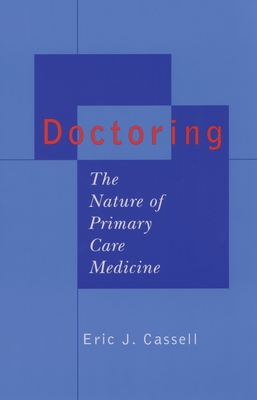
Doctoring: The Nature of Primary Care Medicine
| AUTHOR | Cassell, Eric J. |
| PUBLISHER | Oxford University Press (11/14/2002) |
| PRODUCT TYPE | Paperback (Paperback) |
Description
American medicine attracts some of the brightest and most motivated people the country has to offer, and it boasts the most advanced medical technology in the world, a wondrous parade of machines and techniques such as PET scans, MRI, angioplasty, endoscopy, bypasses, organ transplants, and much more besides. And yet, writes Dr. Eric Cassell, what started out early in the century as the exciting conquest of disease, has evolved into an overly expensive, over technologized, uncaring medicine, poorly suited to the health care needs of a society marked by an aging population and a predominance of chronic diseases. In Doctoring: The Nature of Primary Care Medicine, Dr. Cassell shows convincingly how much better fitted advanced concepts of primary care medicine are to America's health care needs. He offers valuable insights into how primary care physicians can be better trained to meet the needs of their patients, both well and sick, and to keep these patients as the focus of their practice.
Modern medical training arose at a time when medical science was in ascendancy, Cassell notes. Thus the ideals of science--objectivity, rationality--became the ideals of medicine, and disease--the target of most medical research--became the logical focus of medical practice. When clinicians treat a patient with pneumonia, they are apt to be thinking about pneumonia in general--which is how they learn about the disease--rather than this person's pneumonia. This objective, rational approach has its value, but when it dominates a physician's approach to medicine, it can create problems. For instance, treating chronic disease--such as rheumatoid arthritis, diabetes, stroke, emphysema, and congestive heart failure--is not simply a matter of medical knowledge, for it demands a great deal of effort by the patients themselves: they have to keep their doctor appointments, take their medication, do their exercises, stop smoking. The patient thus has a profound effect on the course of the disease, and so for a physician to succeed, he or she must also be familiar with the patient's motivations, values, concerns, and relationship with the doctor. Many doctors eventually figure out how to put the patient at the center of their practice, but they should learn to do this at the training level, not haphazardly over time. To that end, the training of primary care physicians must recognize a distinction between doctoring itself and the medical science on which it is based, and should try to produce doctors who rely on both their scientific and subjective assessments of their patients' overall needs. There must be a return to careful observational and physical examination skills and finely tuned history taking and communication skills. Cassell also advocates the need to teach the behavior of both sick and well persons, evaluation of data from clinical epidemiology, decision making skills, and preventive medicine, as well as actively teaching how to make technology the servant rather than the master, and offers practical tips for instruction both in the classroom and in practice.
Most important, Doctoring argues convincingly that primary care medicine should become a central focus of America's health care system, not merely a cost-saving measure as envisioned by managed care organizations. Indeed, Cassell shows that the primary care physician can fulfill a unique role in the medical community, and a vital role in society in general. He shows that primary care medicine is not a retreat from scientific medicine, but the natural next step for medicine to take in the coming century.
Modern medical training arose at a time when medical science was in ascendancy, Cassell notes. Thus the ideals of science--objectivity, rationality--became the ideals of medicine, and disease--the target of most medical research--became the logical focus of medical practice. When clinicians treat a patient with pneumonia, they are apt to be thinking about pneumonia in general--which is how they learn about the disease--rather than this person's pneumonia. This objective, rational approach has its value, but when it dominates a physician's approach to medicine, it can create problems. For instance, treating chronic disease--such as rheumatoid arthritis, diabetes, stroke, emphysema, and congestive heart failure--is not simply a matter of medical knowledge, for it demands a great deal of effort by the patients themselves: they have to keep their doctor appointments, take their medication, do their exercises, stop smoking. The patient thus has a profound effect on the course of the disease, and so for a physician to succeed, he or she must also be familiar with the patient's motivations, values, concerns, and relationship with the doctor. Many doctors eventually figure out how to put the patient at the center of their practice, but they should learn to do this at the training level, not haphazardly over time. To that end, the training of primary care physicians must recognize a distinction between doctoring itself and the medical science on which it is based, and should try to produce doctors who rely on both their scientific and subjective assessments of their patients' overall needs. There must be a return to careful observational and physical examination skills and finely tuned history taking and communication skills. Cassell also advocates the need to teach the behavior of both sick and well persons, evaluation of data from clinical epidemiology, decision making skills, and preventive medicine, as well as actively teaching how to make technology the servant rather than the master, and offers practical tips for instruction both in the classroom and in practice.
Most important, Doctoring argues convincingly that primary care medicine should become a central focus of America's health care system, not merely a cost-saving measure as envisioned by managed care organizations. Indeed, Cassell shows that the primary care physician can fulfill a unique role in the medical community, and a vital role in society in general. He shows that primary care medicine is not a retreat from scientific medicine, but the natural next step for medicine to take in the coming century.
Show More
Product Format
Product Details
ISBN-13:
9780195158625
ISBN-10:
0195158628
Binding:
Paperback or Softback (Trade Paperback (Us))
Content Language:
English
More Product Details
Page Count:
224
Carton Quantity:
40
Product Dimensions:
6.14 x 0.64 x 9.26 inches
Weight:
0.76 pound(s)
Country of Origin:
US
Subject Information
BISAC Categories
Medical | Family & General Practice
Accelerated Reader:
Reading Level:
0
Point Value:
0
Guided Reading Level:
Not Applicable
Dewey Decimal:
610
Descriptions, Reviews, Etc.
publisher marketing
American medicine attracts some of the brightest and most motivated people the country has to offer, and it boasts the most advanced medical technology in the world, a wondrous parade of machines and techniques such as PET scans, MRI, angioplasty, endoscopy, bypasses, organ transplants, and much more besides. And yet, writes Dr. Eric Cassell, what started out early in the century as the exciting conquest of disease, has evolved into an overly expensive, over technologized, uncaring medicine, poorly suited to the health care needs of a society marked by an aging population and a predominance of chronic diseases. In Doctoring: The Nature of Primary Care Medicine, Dr. Cassell shows convincingly how much better fitted advanced concepts of primary care medicine are to America's health care needs. He offers valuable insights into how primary care physicians can be better trained to meet the needs of their patients, both well and sick, and to keep these patients as the focus of their practice.
Modern medical training arose at a time when medical science was in ascendancy, Cassell notes. Thus the ideals of science--objectivity, rationality--became the ideals of medicine, and disease--the target of most medical research--became the logical focus of medical practice. When clinicians treat a patient with pneumonia, they are apt to be thinking about pneumonia in general--which is how they learn about the disease--rather than this person's pneumonia. This objective, rational approach has its value, but when it dominates a physician's approach to medicine, it can create problems. For instance, treating chronic disease--such as rheumatoid arthritis, diabetes, stroke, emphysema, and congestive heart failure--is not simply a matter of medical knowledge, for it demands a great deal of effort by the patients themselves: they have to keep their doctor appointments, take their medication, do their exercises, stop smoking. The patient thus has a profound effect on the course of the disease, and so for a physician to succeed, he or she must also be familiar with the patient's motivations, values, concerns, and relationship with the doctor. Many doctors eventually figure out how to put the patient at the center of their practice, but they should learn to do this at the training level, not haphazardly over time. To that end, the training of primary care physicians must recognize a distinction between doctoring itself and the medical science on which it is based, and should try to produce doctors who rely on both their scientific and subjective assessments of their patients' overall needs. There must be a return to careful observational and physical examination skills and finely tuned history taking and communication skills. Cassell also advocates the need to teach the behavior of both sick and well persons, evaluation of data from clinical epidemiology, decision making skills, and preventive medicine, as well as actively teaching how to make technology the servant rather than the master, and offers practical tips for instruction both in the classroom and in practice.
Most important, Doctoring argues convincingly that primary care medicine should become a central focus of America's health care system, not merely a cost-saving measure as envisioned by managed care organizations. Indeed, Cassell shows that the primary care physician can fulfill a unique role in the medical community, and a vital role in society in general. He shows that primary care medicine is not a retreat from scientific medicine, but the natural next step for medicine to take in the coming century.
Modern medical training arose at a time when medical science was in ascendancy, Cassell notes. Thus the ideals of science--objectivity, rationality--became the ideals of medicine, and disease--the target of most medical research--became the logical focus of medical practice. When clinicians treat a patient with pneumonia, they are apt to be thinking about pneumonia in general--which is how they learn about the disease--rather than this person's pneumonia. This objective, rational approach has its value, but when it dominates a physician's approach to medicine, it can create problems. For instance, treating chronic disease--such as rheumatoid arthritis, diabetes, stroke, emphysema, and congestive heart failure--is not simply a matter of medical knowledge, for it demands a great deal of effort by the patients themselves: they have to keep their doctor appointments, take their medication, do their exercises, stop smoking. The patient thus has a profound effect on the course of the disease, and so for a physician to succeed, he or she must also be familiar with the patient's motivations, values, concerns, and relationship with the doctor. Many doctors eventually figure out how to put the patient at the center of their practice, but they should learn to do this at the training level, not haphazardly over time. To that end, the training of primary care physicians must recognize a distinction between doctoring itself and the medical science on which it is based, and should try to produce doctors who rely on both their scientific and subjective assessments of their patients' overall needs. There must be a return to careful observational and physical examination skills and finely tuned history taking and communication skills. Cassell also advocates the need to teach the behavior of both sick and well persons, evaluation of data from clinical epidemiology, decision making skills, and preventive medicine, as well as actively teaching how to make technology the servant rather than the master, and offers practical tips for instruction both in the classroom and in practice.
Most important, Doctoring argues convincingly that primary care medicine should become a central focus of America's health care system, not merely a cost-saving measure as envisioned by managed care organizations. Indeed, Cassell shows that the primary care physician can fulfill a unique role in the medical community, and a vital role in society in general. He shows that primary care medicine is not a retreat from scientific medicine, but the natural next step for medicine to take in the coming century.
Show More
Author:
Cassell, Eric J.
Eric J. Cassell is Clinical Professor of Public Health at Cornell University Medical College, and an attending physician at The New York Hospital. He is a fellow of the Hastings Center and a member of the Institute of Medicine of The National Academy of Sciences. He is the author of The Healer's
Art, The Place of Humanities in Medicine, and Talking with Patients.
Art, The Place of Humanities in Medicine, and Talking with Patients.
Show More
List Price $40.99
Your Price
$40.58