
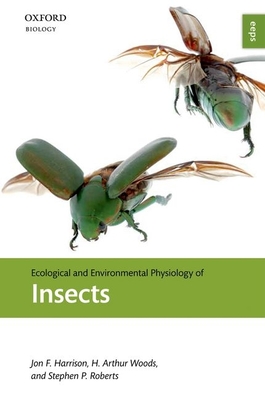
Ecological and Environmental Physiology of Insects
| AUTHOR | Roberts, Stephen P.; Woods, H. Arthur; Harrison, Jon F. |
| PUBLISHER | Academic (03/23/2017) |
| PRODUCT TYPE | Hardcover (Hardcover) |
Description
Insects are the most ecologically important multicellular heterotrophs in terrestrial systems. They play critical roles in ecological food webs, remain devastating agricultural and medical pests, and represent the most diverse group of eukaryotes in terms of species numbers. Their dominant role among terrestrial heterotrophs arises from a number of key physiological traits, and in particular by the developmental and evolutionary plasticity of these traits. Ecological and Environmental Physiology of Insects presents a current and comprehensive overview of how the key physiological traits of insects respond to environmental variation. It forges conceptual links from molecular biology through organismal function to population and community ecology. As with other books in the Series, the emphasis is on the unique physiological characteristics of the insects, but with applications to questions of broad relevance in physiological ecology. As an aid to new researchers on insects, it also includes introductory chapters on the basics and techniques of insect physiology ecology.
Show More
Product Format
Product Details
ISBN-13:
9780199225941
ISBN-10:
019922594X
Binding:
Hardback or Cased Book (Sewn)
Content Language:
English
More Product Details
Page Count:
372
Carton Quantity:
18
Product Dimensions:
9.30 x 1.00 x 6.40 inches
Weight:
1.79 pound(s)
Feature Codes:
Bibliography,
Index,
Illustrated
Country of Origin:
GB
Subject Information
BISAC Categories
Science | Life Sciences - Zoology - Entomology
Science | Non-Classifiable
Dewey Decimal:
595.717
Library of Congress Control Number:
2012405045
Descriptions, Reviews, Etc.
publisher marketing
Insects are the most ecologically important multicellular heterotrophs in terrestrial systems. They play critical roles in ecological food webs, remain devastating agricultural and medical pests, and represent the most diverse group of eukaryotes in terms of species numbers. Their dominant role among terrestrial heterotrophs arises from a number of key physiological traits, and in particular by the developmental and evolutionary plasticity of these traits. Ecological and Environmental Physiology of Insects presents a current and comprehensive overview of how the key physiological traits of insects respond to environmental variation. It forges conceptual links from molecular biology through organismal function to population and community ecology. As with other books in the Series, the emphasis is on the unique physiological characteristics of the insects, but with applications to questions of broad relevance in physiological ecology. As an aid to new researchers on insects, it also includes introductory chapters on the basics and techniques of insect physiology ecology.
Show More
List Price $155.00
Your Price
$153.45