
Back to Search

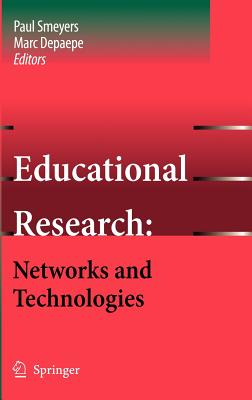
Educational Research: Networks and Technologies

PUBLISHER Springer (10/08/2007)
PRODUCT TYPE Hardcover (Hardcover)

Description
PAUL SMEYERS AND MARC DEPAEPE THE FRAMEWORK OF THE COLLABORATIVE PROJECT This is the third book that resulted from the close collaboration within the Research Community 'Philosophy and History of the Discipline of Education: Evaluation and Evolution of the Criteria for Educational Research', established by the Research Foun- 1 dation Flanders, Belgium (Fonds voor Wetenschappelijk Onderzoek - Vlaanderen). From the beginning, the aim of the network has been to combine research c- cerning the history and nature of the discipline with the science of education. Clarification, evaluation and justification of the different modes and paradigms of educational research are thus taken into account. The academics involved in this network share the belief that there is a place within the discipline of education for so-called foundationalist approaches. This is not, however, to answer a need for a (new) foundation, but to systematically study a particular area from a discipli- oriented stance. The essays, published in 2003 under the title Beyond Empiricism: On Criteria for Educational Research (Smeyers and Depaepe, 2003), bear witness to the belief that educational theory cannot help but go beyond empirical educational research to provide a real understanding of education as a human practice. Edu- tional research is discussed respectively as a social discourse, as a discursive practice, in relation to epistemological issues and in the light of questions of ethics.
Show More
Product Format
Product Details
ISBN-13: 9781402066122
ISBN-10: 1402066120
Binding: Hardback or Cased Book (Sewn)
Content Language: English
More Product Details
Page Count: 228
Carton Quantity: 34
Product Dimensions: 6.14 x 0.56 x 9.21 inches
Weight: 1.12 pound(s)
Feature Codes: Illustrated
Country of Origin: NL
Subject Information
BISAC Categories
Science | History
Science | Philosophy, Theory & Social Aspects
Science | Schools - Levels - Higher
Dewey Decimal: 370.7
Descriptions, Reviews, Etc.
jacket back

There have always been networks in the context of educational research as well as particular technologies. Yet recent developments in ICT have put their mark on contemporary education and on educational research and more in general on knowledge and understanding. Does the 'network society' and its supporting technologies constitute a thoroughly radical innovation in social practice? Does information technology poison the minds of the younger generation? Do educational institutions have to be transformed in order to effectively serve the needs of the twenty-first century? And what are the implications of these changes for educational research and for researchers themselves?

In this book distinguished philosophers and historians of education focus on the way 'networks' and 'technologies' characterize education and educational research nowadays. Attention is paid for instance to online networks as 'spaces' and 'places' that are changing research practices and relations, to the involvement of the researcher in the moral debate, but also to particular educational technologies such as the use of experts' advice concerning Internet use, the American True Love Waits movement and the practice of punishment in schools.

"This groundbreaking book records the intellectual struggles of a diverse and distinguished group of scholars as they come to grips with the changes in knowledge production, and modes of research communication, engendered by contemporary information and communications technology. The book performs a major service in placing the phenomenon of networks - their potentialities and also their dangers - squarely on our intellectual agenda."

D.C. Phillips, Professor Emeritus of Education and Philosophy, Stanford University

"In this book, a rich array of international scholars in the philosophy and history of education address a pressing concern in contemporary educational research and educationalpractice: the impact of information technology and networks. The authors are strikingly successful, both in explicating the effects of these changes on both domains and in subverting these effects by pointing out the ironies and continuities lodged beneath technology's veneer of utility and novelty."

David F. Labaree, Professor of Education, Stanford University

This publication is realized by the Research Community (FWO-Vlaanderen / Research Foundation Flanders, Belgium) Philosophy and History of the Discipline of Education: Evaluation and Evolution of the Criteria for Educational Research. Also realized by the Research Community is Educational Research: Why "What Works" Doesn't Work, which appeared in 2006.

Show More
publisher marketing
PAUL SMEYERS AND MARC DEPAEPE THE FRAMEWORK OF THE COLLABORATIVE PROJECT This is the third book that resulted from the close collaboration within the Research Community 'Philosophy and History of the Discipline of Education: Evaluation and Evolution of the Criteria for Educational Research', established by the Research Foun- 1 dation Flanders, Belgium (Fonds voor Wetenschappelijk Onderzoek - Vlaanderen). From the beginning, the aim of the network has been to combine research c- cerning the history and nature of the discipline with the science of education. Clarification, evaluation and justification of the different modes and paradigms of educational research are thus taken into account. The academics involved in this network share the belief that there is a place within the discipline of education for so-called foundationalist approaches. This is not, however, to answer a need for a (new) foundation, but to systematically study a particular area from a discipli- oriented stance. The essays, published in 2003 under the title Beyond Empiricism: On Criteria for Educational Research (Smeyers and Depaepe, 2003), bear witness to the belief that educational theory cannot help but go beyond empirical educational research to provide a real understanding of education as a human practice. Edu- tional research is discussed respectively as a social discourse, as a discursive practice, in relation to epistemological issues and in the light of questions of ethics.
Show More

Editor: Depaepe, Marc
Marc Depaepe is Professor of History of Education at the University of Leuven.
Show More

Editor: Smeyers, Paul
Paul Smeyers is Research Professor for Philosophy of Education at Ghent University and Extraordinary Professor at KU Leuven, both in Belgium, and Honorary Extraordinary Professor at Stellenbosch University, South Africa. He teaches philosophy of education and methodology of qualitative/interpretative research methods. He is President of the International Network of Philosophers of Education and link-convenor for Network 13, Philosophy of Education of the European Educational Research Association. Since January 2014 he has been the editor of Ethics and Education.
Show More
List Price $109.99
Your Price  $108.89
Hardcover