
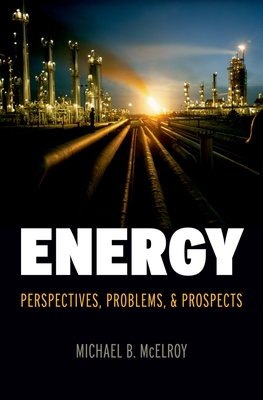
Energy: Perspectives, Problems, and Prospects
| AUTHOR | McElroy, Michael B. |
| PUBLISHER | Oxford University Press, USA (12/21/2009) |
| PRODUCT TYPE | Hardcover (Hardcover) |
Description
The book offers a comprehensive account of how the world evolved to its present state in which humans now exercise a powerful, in many cases dominant, influence for global environmental change. It outlines the history that led to this position of dominance, in particular the role played by our increasing reliance on fossil sources of energy, on coal, oil and natural gas, and the problems that we are now forced to confront as a result of this history. The concentration of carbon dioxide in the atmosphere is greater now than at any time over at least the past 650,000 years with prospects to increase over the next few decades to levels not seen since dinosaurs roamed the Earth 65 million years ago. Comparable changes are evident also for methane and nitrous oxide and for a variety of other constituents of the atmosphere including species such as the ozone depleting chlorofluorocarbons for which there are no natural analogues. Increases in the concentrations of so-called greenhouse gases in the atmosphere are responsible for important changes in global and regional climate with consequences for the future of global society which, though difficult to predict in detail, are potentially catastrophic for a world poorly equipped to cope. Changes of climate in the past were repetitively responsible for the demise of important civilizations. These changes, however, were generally natural in origin in contrast to the changes now underway for which humans are directly responsible. The challenge is to transition to a new energy economy in which fossil fuels will play a much smaller role. We need as a matter of urgency to cut back on emissions of climate altering gases such as carbon dioxide while at the same time reducing our dependence on unreliable, potentially disruptive, though currently indispensable, sources of energy such as oil, the lifeblood of the global transportation system. The book concludes with a
discussion of options for a more sustainable energy future, highlighting the potential for contributions from wind, sun, biomass, geothermal and nuclear, supplanting currently unsustainable reliance on coal, oil and natural gas.
discussion of options for a more sustainable energy future, highlighting the potential for contributions from wind, sun, biomass, geothermal and nuclear, supplanting currently unsustainable reliance on coal, oil and natural gas.
Show More
Product Format
Product Details
ISBN-13:
9780195386110
ISBN-10:
0195386116
Binding:
Hardback or Cased Book (Sewn)
Content Language:
English
More Product Details
Page Count:
424
Carton Quantity:
1
Product Dimensions:
6.40 x 1.10 x 9.30 inches
Weight:
1.65 pound(s)
Feature Codes:
Bibliography,
Index,
Maps,
Illustrated
Country of Origin:
US
Subject Information
BISAC Categories
Science | Energy
Science | Environmental Science (see also Chemistry - Environmental)
Science | Linguistics - General
Dewey Decimal:
333.79
Library of Congress Control Number:
2009007390
Descriptions, Reviews, Etc.
publisher marketing
The book offers a comprehensive account of how the world evolved to its present state in which humans now exercise a powerful, in many cases dominant, influence for global environmental change. It outlines the history that led to this position of dominance, in particular the role played by our increasing reliance on fossil sources of energy, on coal, oil and natural gas, and the problems that we are now forced to confront as a result of this history. The concentration of carbon dioxide in the atmosphere is greater now than at any time over at least the past 650,000 years with prospects to increase over the next few decades to levels not seen since dinosaurs roamed the Earth 65 million years ago. Comparable changes are evident also for methane and nitrous oxide and for a variety of other constituents of the atmosphere including species such as the ozone depleting chlorofluorocarbons for which there are no natural analogues. Increases in the concentrations of so-called greenhouse gases in the atmosphere are responsible for important changes in global and regional climate with consequences for the future of global society which, though difficult to predict in detail, are potentially catastrophic for a world poorly equipped to cope. Changes of climate in the past were repetitively responsible for the demise of important civilizations. These changes, however, were generally natural in origin in contrast to the changes now underway for which humans are directly responsible. The challenge is to transition to a new energy economy in which fossil fuels will play a much smaller role. We need as a matter of urgency to cut back on emissions of climate altering gases such as carbon dioxide while at the same time reducing our dependence on unreliable, potentially disruptive, though currently indispensable, sources of energy such as oil, the lifeblood of the global transportation system. The book concludes with a
discussion of options for a more sustainable energy future, highlighting the potential for contributions from wind, sun, biomass, geothermal and nuclear, supplanting currently unsustainable reliance on coal, oil and natural gas.
discussion of options for a more sustainable energy future, highlighting the potential for contributions from wind, sun, biomass, geothermal and nuclear, supplanting currently unsustainable reliance on coal, oil and natural gas.
Show More
List Price $110.00
Your Price
$108.90