
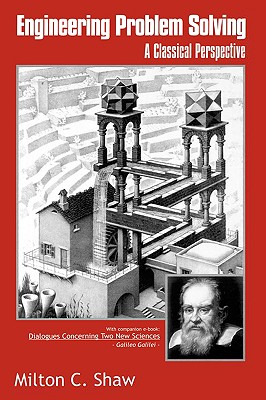
ISBN 9780815514473 is out of print and is currently unavailable, alternate formats (if applicable) are shown below.
Available options are listed below:
Available options are listed below:
Engineering Problem Solving: A Classical Perspective (Out of print)
| AUTHOR | Shaw, Milton Clayton; Shaw, Milton C.; Shaw, Milton Clayton et al. |
| PUBLISHER | William Andrew (12/31/2001) |
| PRODUCT TYPE | Hardcover (Hardcover) |
Description
Engineering, at its origins, was a profession of problem solving. The classic text, Dialogues Concerning Two New Sciences by Galileo Galilei is revisited in this ambitious and comprehensive book by Milton Shaw. In-depth discussions of passages from the Galileo text emphasize the ""mind set"" of engineering, specifically the roles played by experimentation and dialog in analysis and creativity. In the epilogue, the author points out that engineering students are usually exposed to two types of faculty. The first type is mathematically oriented and mostly interested in analytical solutions. The second type is interested in devising and experimenting with innovative solutions. However, since many talented graduates move directly into teaching instead of gaining real world experience, an imbalance of analytical teaching has occurred. Shaw points out through an example by Dr. Dave Lineback that learning to solve practical engineering problems is a very important part of an engineer's education, but is often denied due to expense and time and effort required. This book fills in many of the gaps in engineering education by showing students, and professionals, the historical background of problem solving.Among those who will find this book particularly useful are engineers working in cross-disciplinary capacities, such as mechanical engineers working with electrical engineering concepts or polymeric materials, engineers preparing for professional engineering exams, mid-career engineers looking to broaden their problem-solving skills, and students looking for help growing their skills.
Show More
Product Format
Product Details
ISBN-13:
9780815514473
ISBN-10:
0815514476
Binding:
Hardback or Cased Book (Sewn)
Content Language:
English
More Product Details
Page Count:
450
Carton Quantity:
16
Product Dimensions:
6.26 x 1.31 x 9.18 inches
Weight:
1.74 pound(s)
Feature Codes:
Bibliography,
Index
Country of Origin:
US
Subject Information
BISAC Categories
Technology & Engineering | Engineering (General)
Technology & Engineering | Teaching - Subjects - Science & Technology
Technology & Engineering | Mechanical
Dewey Decimal:
620.001
Library of Congress Control Number:
00022003
Descriptions, Reviews, Etc.
annotation
This book fills in many of the gaps in engineering education by showing students and professionals the historical background of problem solving. By revisiting Galileo Galilei's classic text, "Dialogues Concerning Two New Sciences", the author discusses the roles played by experimentation and analysis. He provides a thorough treatment of similitude, dimensional analysis, and computers as problem solving tools.
Show More
publisher marketing
Engineering, at its origins, was a profession of problem solving. The classic text, Dialogues Concerning Two New Sciences by Galileo Galilei is revisited in this ambitious and comprehensive book by Milton Shaw. In-depth discussions of passages from the Galileo text emphasize the ""mind set"" of engineering, specifically the roles played by experimentation and dialog in analysis and creativity. In the epilogue, the author points out that engineering students are usually exposed to two types of faculty. The first type is mathematically oriented and mostly interested in analytical solutions. The second type is interested in devising and experimenting with innovative solutions. However, since many talented graduates move directly into teaching instead of gaining real world experience, an imbalance of analytical teaching has occurred. Shaw points out through an example by Dr. Dave Lineback that learning to solve practical engineering problems is a very important part of an engineer's education, but is often denied due to expense and time and effort required. This book fills in many of the gaps in engineering education by showing students, and professionals, the historical background of problem solving.Among those who will find this book particularly useful are engineers working in cross-disciplinary capacities, such as mechanical engineers working with electrical engineering concepts or polymeric materials, engineers preparing for professional engineering exams, mid-career engineers looking to broaden their problem-solving skills, and students looking for help growing their skills.
Show More
List Price $106.25
Your Price
$105.19