
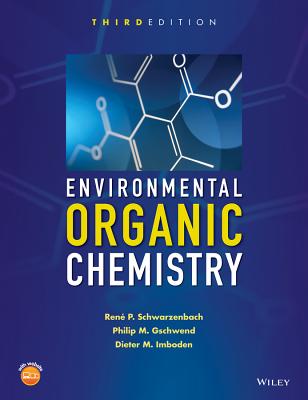
Environmental Organic Chemistry
| AUTHOR | Schwarzenbach, Rene P.; Imboden, Dieter M.; Schwarzenbach et al. |
| PUBLISHER | Wiley (11/07/2016) |
| PRODUCT TYPE | Paperback (Paperback) |
A Completely Revised and Updated Edition of the Authorative Text in Environmental Organic Chemistry
Environmental Organic Chemistry, Third Edition focuses on the molecular processes and macroscopic transport phenomena that determine the spatiotemporal distributions of organic chemicals released into the environment; this knowledge is then applied to quantitatively assess the fates of those chemicals in natural and engineered systems.
Long established as the discipline's authoritative text, the third edition of Environmental Organic Chemistry significantly revises, regroups, and expands the contents of its predecessor along with a complete account of the state of the art of the field. By explaining in a pedagogical way how to relate the structure of a given chemical to its physical chemical properties and intrinsic reactivities, by providing the necessary background knowledge on the chemistry and physics of microscopic and macroscopic environmental systems, and by introducing simple modeling approaches, the reader is able to quantify phase transfers, transformations, and transport processes at each level. Compared to the 2nd edition, the 3rd edition provides a more holistic and teachable description of partitioning and transformation processes, as well as a more focused and tailor-made presentation of physical and mathematical modeling aspects. Divided into six main parts, Environmental Organic Chemistry, Third Edition features:
- Pertinent background knowledge on the make-up and on the use of anthropogenic organic chemicals, on the thermodynamics and kinetics of partitioning and transformation processes, on the molecular interactions governing partitioning processes, on the chemical and physical characteristics of environmental systems, and on simple modeling approaches used to quantitatively assess organic chemicals
- A quantitative treatment of equilibrium partitioning of organic chemicals in well-defined as well as in environmental systems including air--water partitioning, sorption from air or water to organic and inorganic sorbents, and bioaccumulation in aquatic and terrestrial systems
- A quantitative treatment of transport processes across interfaces and its application to atmosphere--surface water, atmosphere--soil, and sediment bed--water exchanges.
- A quantitative treatment of chemical, photochemical, and microbiological transformation processes including a new chapter on the use of compound-specific isotope analysis to assess transformation reactions in laboratory and field systems
- Case studies illustrating how to put everything together using simple modeling approaches
Intended as a comprehensive text for (introductory) courses in environmental organic chemistry at the graduate level, as well as an important source of information for risk assessment of organic chemicals and for solving practical problems at contaminated sites, Environmental Organic Chemistry, Third Edition continues to make a significant contribution to the education of environmental scientists and engineers and, thus, to a better protection of our environment.
A Completely Revised and Updated Edition of the Authorative Text in Environmental Organic Chemistry
Environmental Organic Chemistry, Third Edition focuses on the molecular processes and macroscopic transport phenomena that determine the spatiotemporal distributions of organic chemicals released into the environment; this knowledge is then applied to quantitatively assess the fates of those chemicals in natural and engineered systems.
Long established as the discipline's authoritative text, the third edition of Environmental Organic Chemistry significantly revises, regroups, and expands the contents of its predecessor along with a complete account of the state of the art of the field. By explaining in a pedagogical way how to relate the structure of a given chemical to its physical chemical properties and intrinsic reactivities, by providing the necessary background knowledge on the chemistry and physics of microscopic and macroscopic environmental systems, and by introducing simple modeling approaches, the reader is able to quantify phase transfers, transformations, and transport processes at each level. Compared to the 2nd edition, the 3rd edition provides a more holistic and teachable description of partitioning and transformation processes, as well as a more focused and tailor-made presentation of physical and mathematical modeling aspects. Divided into six main parts, Environmental Organic Chemistry, Third Edition features:
- Pertinent background knowledge on the make-up and on the use of anthropogenic organic chemicals, on the thermodynamics and kinetics of partitioning and transformation processes, on the molecular interactions governing partitioning processes, on the chemical and physical characteristics of environmental systems, and on simple modeling approaches used to quantitatively assess organic chemicals
- A quantitative treatment of equilibrium partitioning of organic chemicals in well-defined as well as in environmental systems including air--water partitioning, sorption from air or water to organic and inorganic sorbents, and bioaccumulation in aquatic and terrestrial systems
- A quantitative treatment of transport processes across interfaces and its application to atmosphere--surface water, atmosphere--soil, and sediment bed--water exchanges.
- A quantitative treatment of chemical, photochemical, and microbiological transformation processes including a new chapter on the use of compound-specific isotope analysis to assess transformation reactions in laboratory and field systems
- Case studies illustrating how to put everything together using simple modeling approaches
Intended as a comprehensive text for (introductory) courses in environmental organic chemistry at the graduate level, as well as an important source of information for risk assessment of organic chemicals and for solving practical problems at contaminated sites, Environmental Organic Chemistry, Third Edition continues to make a significant contribution to the education of environmental scientists and engineers and, thus, to a better protection of our environment.