
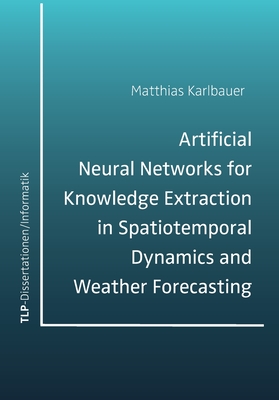
Artificial Neural Networks for Knowledge Extraction in Spatiotemporal Dynamics and Weather Forecasting
| AUTHOR | Karlbauer, Matthias |
| PUBLISHER | Tubingen Library Publishing (03/18/2025) |
| PRODUCT TYPE | Paperback (Paperback) |
Description
This thesis explores the potential of machine learning methods for improving weather forecasts. Since weather is considered a spatiotemporal process that evolves over space through time, the thesis first investigates the design choices required for machine learning models to simulate synthetic spatiotemporal processes, such as the two-dimensional wave equation. It then develops a method for analyzing machine learning models that enables the extraction of unknown process-relevant context that parameterizes an observed simulated spatiotemporal process of interest. Relating these extracted factors to physical properties leads the thesis to physics-aware machine learning, where it explores how to fuse process knowledge from physics with the learning ability of artificial neural networks. Given the insights from those investigations, a competitive deep learning weather prediction model is designed to understand which design choices support data-driven algorithms to learn a meaningful function that predicts realistic and stable states of the atmosphere over hundreds of hours, days, and weeks into the future.
Show More
Product Format
Product Details
ISBN-13:
9783989440258
ISBN-10:
398944025X
Binding:
Paperback or Softback (Trade Paperback (Us))
Content Language:
German
More Product Details
Page Count:
190
Carton Quantity:
22
Product Dimensions:
6.69 x 0.40 x 9.61 inches
Weight:
0.69 pound(s)
Country of Origin:
US
Subject Information
BISAC Categories
Computers | Computer Science
Descriptions, Reviews, Etc.
publisher marketing
This thesis explores the potential of machine learning methods for improving weather forecasts. Since weather is considered a spatiotemporal process that evolves over space through time, the thesis first investigates the design choices required for machine learning models to simulate synthetic spatiotemporal processes, such as the two-dimensional wave equation. It then develops a method for analyzing machine learning models that enables the extraction of unknown process-relevant context that parameterizes an observed simulated spatiotemporal process of interest. Relating these extracted factors to physical properties leads the thesis to physics-aware machine learning, where it explores how to fuse process knowledge from physics with the learning ability of artificial neural networks. Given the insights from those investigations, a competitive deep learning weather prediction model is designed to understand which design choices support data-driven algorithms to learn a meaningful function that predicts realistic and stable states of the atmosphere over hundreds of hours, days, and weeks into the future.
Show More
List Price $22.50
Your Price
$22.28