
Available options are listed below:
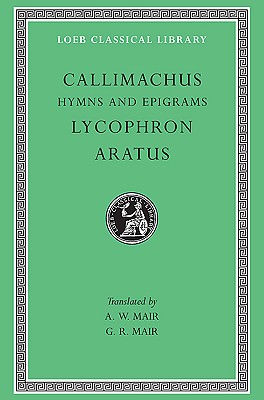
Hymns and Epigrams. Lycophron: Alexandra. Aratus: Phaenomena (Out of print)
| AUTHOR | Callimachus; Aratus; Lycophron |
| PUBLISHER | Harvard University Press (01/01/1921) |
| PRODUCT TYPE | Hardcover (Hardcover) |
Callimachus of Cyrene, 3rd century BCE, became after 284 a teacher of grammar and poetry at Alexandria. He was made a librarian in the new library there and prepared a catalogue of its books. He died about the year 240. Of his large published output, only 6 hymns, 63 epigrams, and fragments survive (the fragments are in Loeb no. 421). The hymns are very learned and artificial in style; the epigrams are good (they are also in the Loeb Greek Anthology volumes).
Lycophron of Chalcis in Euboea was a contemporary of Callimachus in Alexandria where he became supervisor of the comedies included in the new library. He wrote a treatise on these and composed tragedies and other poetry. We possess Alexandra or Cassandra wherein Cassandra foretells the fortune of Troy and the besieging Greeks. This poem is a curiosity--a showpiece of knowledge of obscure stories, names, and words.
Aratus of Soli in Cilicia, ca. 315-245 BCE, was a didactic poet at the court of Antigonus Gonatas of Macedonia, where he wrote his famous astronomical poem Phaenomena (Appearances). He was for a time in the court of Antiochus I of Syria but returned to Macedonia. Phaenomena was highly regarded in antiquity; it was translated into Latin by Cicero, Germanicus Caesar, and Avienus.
Callimachus of Cyrene, 3rd century BCE, became after 284 a teacher of grammar and poetry at Alexandria. He was made a librarian in the new library there and prepared a catalogue of its books. He died about the year 240. Of his large published output, only 6 hymns, 63 epigrams, and fragments survive (the fragments are in Loeb no. 421). The hymns are very learned and artificial in style; the epigrams are good (they are also in the Loeb Greek Anthology volumes).
Lycophron of Chalcis in Euboea was a contemporary of Callimachus in Alexandria where he became supervisor of the comedies included in the new library. He wrote a treatise on these and composed tragedies and other poetry. We possess Alexandra or Cassandra wherein Cassandra foretells the fortune of Troy and the besieging Greeks. This poem is a curiosity--a showpiece of knowledge of obscure stories, names, and words.
Aratus of Soli in Cilicia, ca. 315-245 BCE, was a didactic poet at the court of Antigonus Gonatas of Macedonia, where he wrote his famous astronomical poem Phaenomena (Appearances). He was for a time in the court of Antiochus I of Syria but returned to Macedonia. Phaenomena was highly regarded in antiquity; it was translated into Latin by Cicero, Germanicus Caesar, and Avienus.