
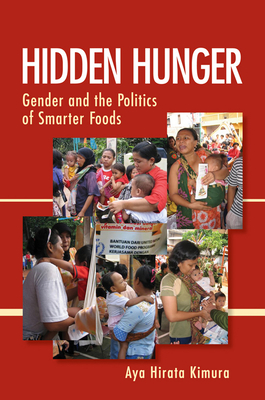
Hidden Hunger: Gender and the Politics of Smarter Foods
| AUTHOR | Kimura, Aya Hirata |
| PUBLISHER | Cornell University Press (02/15/2013) |
| PRODUCT TYPE | Paperback (Paperback) |
For decades, NGOs targeting world hunger focused on ensuring that adequate quantities of food were being sent to those in need. In the 1990s, the international food policy community turned its focus to the "hidden hunger" of micronutrient deficiencies, a problem that resulted in two scientific solutions: fortification, the addition of nutrients to processed foods, and biofortification, the modification of crops to produce more nutritious yields. This hidden hunger was presented as a scientific problem to be solved by "experts" and scientifically engineered smart foods rather than through local knowledge, which was deemed unscientific and, hence, irrelevant.In Hidden Hunger, Aya Hirata Kimura explores this recent emphasis on micronutrients and smart foods within the international development community and, in particular, how the voices of women were silenced despite their expertise in food purchasing and preparation. Kimura grounds her analysis in case studies of attempts to enrich and market three basic foods--rice, wheat flour, and baby food--in Indonesia. She shows the power of nutritionism and how its technical focus enhanced the power of corporations as a government partner while restricting public participation in the making of policy for public health and food. She also analyzes the role of advertising to promote fortified foodstuffs and traces the history of Golden Rice, a crop genetically engineered to alleviate vitamin A deficiencies. Situating the recent turn to smart food in Indonesia and elsewhere as part of a long history of technical attempts to solve the Third World food problem, Kimura deftly analyzes the intersection of scientific expertise, market forces, and gendered knowledge to illuminate how hidden hunger ultimately defined women as victims rather than as active agents.
For decades, NGOs targeting world hunger focused on ensuring that adequate quantities of food were being sent to those in need. In the 1990s, the international food policy community turned its focus to the "hidden hunger" of micronutrient deficiencies, a problem that resulted in two scientific solutions: fortification, the addition of nutrients to processed foods, and biofortification, the modification of crops to produce more nutritious yields. This hidden hunger was presented as a scientific problem to be solved by "experts" and scientifically engineered smart foods rather than through local knowledge, which was deemed unscientific and, hence, irrelevant.In Hidden Hunger, Aya Hirata Kimura explores this recent emphasis on micronutrients and smart foods within the international development community and, in particular, how the voices of women were silenced despite their expertise in food purchasing and preparation. Kimura grounds her analysis in case studies of attempts to enrich and market three basic foods--rice, wheat flour, and baby food--in Indonesia. She shows the power of nutritionism and how its technical focus enhanced the power of corporations as a government partner while restricting public participation in the making of policy for public health and food. She also analyzes the role of advertising to promote fortified foodstuffs and traces the history of Golden Rice, a crop genetically engineered to alleviate vitamin A deficiencies. Situating the recent turn to smart food in Indonesia and elsewhere as part of a long history of technical attempts to solve the Third World food problem, Kimura deftly analyzes the intersection of scientific expertise, market forces, and gendered knowledge to illuminate how hidden hunger ultimately defined women as victims rather than as active agents.