
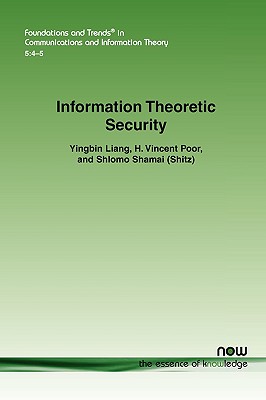
Information Theoretic Security
| AUTHOR | Shamai, Shlomo; Shamai (Shitz), Shlomo; Liang, Yingbin et al. |
| PUBLISHER | Now Publishers (06/22/2009) |
| PRODUCT TYPE | Paperback (Paperback) |
Description
Security is one of the most important issues in communications. Security issues arising in communication networks include confidentiality, integrity, authentication and non-repudiation. Attacks on the security of communication networks can be divided into two basic types: passive attacks and active attacks. An active attack corresponds to the situation in which a malicious actor intentionally disrupts the system. A passive attack corresponds to the situation in which a malicious actor attempts to interpret source information without injecting any information or trying to modify the information; i.e., passive attackers listen to the transmission without modifying it. Information Theoretic Security focuses on confidentiality issues, in which passive attacks are of primary concern. The information theoretic approach to achieving secure communication opens a promising new direction toward solving wireless networking security problems. Compared to contemporary cryptosystems, information theoretic approaches offer advantages such as eliminating the key management issue; are less vulnerable to the man-in-the-middle and achieve provable security that is robust to powerful eavesdroppers possessing unlimited computational resources, knowledge of the communication strategy employed including coding and decoding algorithms, and access to communication systems either through perfect or noisy channels. Information Theoretic Security surveys the research dating back to the 1970s which forms the basis of applying this technique in modern systems. It proceeds to provide an overview of how information theoretic approaches are developed to achieve secrecy for a basic wire-tap channel model as well as for its extensions to multiuser networks. It is an invaluable resource for students and researchers working in network security, information theory and communications.
Show More
Product Format
Product Details
ISBN-13:
9781601982407
ISBN-10:
1601982402
Binding:
Paperback or Softback (Trade Paperback (Us))
Content Language:
English
More Product Details
Page Count:
246
Carton Quantity:
36
Product Dimensions:
6.14 x 0.52 x 9.21 inches
Weight:
0.77 pound(s)
Country of Origin:
US
Subject Information
BISAC Categories
Computers | Computer Engineering
Computers | Information Theory
Computers | Security - General
Dewey Decimal:
005.8
Descriptions, Reviews, Etc.
publisher marketing
Security is one of the most important issues in communications. Security issues arising in communication networks include confidentiality, integrity, authentication and non-repudiation. Attacks on the security of communication networks can be divided into two basic types: passive attacks and active attacks. An active attack corresponds to the situation in which a malicious actor intentionally disrupts the system. A passive attack corresponds to the situation in which a malicious actor attempts to interpret source information without injecting any information or trying to modify the information; i.e., passive attackers listen to the transmission without modifying it. Information Theoretic Security focuses on confidentiality issues, in which passive attacks are of primary concern. The information theoretic approach to achieving secure communication opens a promising new direction toward solving wireless networking security problems. Compared to contemporary cryptosystems, information theoretic approaches offer advantages such as eliminating the key management issue; are less vulnerable to the man-in-the-middle and achieve provable security that is robust to powerful eavesdroppers possessing unlimited computational resources, knowledge of the communication strategy employed including coding and decoding algorithms, and access to communication systems either through perfect or noisy channels. Information Theoretic Security surveys the research dating back to the 1970s which forms the basis of applying this technique in modern systems. It proceeds to provide an overview of how information theoretic approaches are developed to achieve secrecy for a basic wire-tap channel model as well as for its extensions to multiuser networks. It is an invaluable resource for students and researchers working in network security, information theory and communications.
Show More
List Price $125.00
Your Price
$123.75