
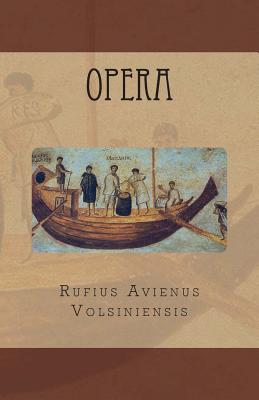
ISBN 9781470029135 is currently unpriced. Please contact us for pricing.
Available options are listed below:
Available options are listed below:
Opera
| AUTHOR | Avienus Volsiniensis, Rufius Festus |
| PUBLISHER | Createspace Independent Publishing Platform (02/05/2012) |
| PRODUCT TYPE | Paperback (Paperback) |
Description
Avienus was a Latin writer of the 4th century AD. According to an inscription from Bulla Regia, his full name was Postumius Rufius Festus (qui et) Avienius. He was a native of Volsinii in Etruria, from the distinguished family of the Rufii Festi. He was twice appointed consul, if an inscription published by the 17th-century antiquaries Jacob Spon and Raffaello Fabretti really refers to this Avienus. Famously asked what he did in the country, he answered Prandeo, poto, cano, ludo, lavo, caeno, quiesco: "I dine, drink, sing, play, bathe, sup, rest." Avienus made somewhat inexact translations into Latin of Aratus' didactic poem Phaenomena. He also took a popular Greek poem in hexameters, Periegesis, briefly delimiting the habitable world from the perspective of Alexandria, written by Dionysius Periegetes in a terse and elegant style that was easy to memorize for students, and translated it into an archaising Latin, as descriptio orbis terrae . Only Book I survives, with an unsteady grasp of actual geography and some far-fetched etymologies. Avienus wrote Ora Maritima ("Sea coasts"), a poem containing borrowings from the early 6th century BC Massiliote Periplus. This poeticised periplus resulted in a confused amateur's account of the coastal regions of the known world. His editor A. Berthelot demonstrated that Avienus' land-measurements were derived from Roman itineraries but inverted some sequences. Berthelot remarked of some names on the Hispanic coast "The omission of Emporium, contrasting strangely with the names of Tarragon and Barcelona, may characterize the method of Avienus, who searches archaic documents and mingles his searches of them with his impressions as an official of the fourth century A.D." (Barthelmy, Introduction). Ora maritima was a work for the reader rather than the traveller, where the fourth century present intrudes largely in the mention of cities at the time abandoned. More recent scholars have emended the too credulous reliance on Avienus' accuracy of his editor, the historian-archaeologist Adolf Schulten. Another ancient chief text cited by Avienus is the Periplus of Himilco, the description of a Punic expedition through the coasts of western Europe which took place at the same time of the circummnavigation of Africa by Hanno (c. 500 BC). Ora Maritima includes reference to the islands of Ierne and Albion, Ireland and Britain, whose inhabitants reputedly traded with the Oestrymnides of Brittany.
Show More
Product Format
Product Details
ISBN-13:
9781470029135
ISBN-10:
1470029138
Binding:
Paperback or Softback (Trade Paperback (Us))
Content Language:
Latin
More Product Details
Page Count:
98
Carton Quantity:
82
Product Dimensions:
5.50 x 0.20 x 8.50 inches
Weight:
0.27 pound(s)
Country of Origin:
US
Subject Information
BISAC Categories
Foreign Language Study | Latin
Descriptions, Reviews, Etc.
publisher marketing
Avienus was a Latin writer of the 4th century AD. According to an inscription from Bulla Regia, his full name was Postumius Rufius Festus (qui et) Avienius. He was a native of Volsinii in Etruria, from the distinguished family of the Rufii Festi. He was twice appointed consul, if an inscription published by the 17th-century antiquaries Jacob Spon and Raffaello Fabretti really refers to this Avienus. Famously asked what he did in the country, he answered Prandeo, poto, cano, ludo, lavo, caeno, quiesco: "I dine, drink, sing, play, bathe, sup, rest." Avienus made somewhat inexact translations into Latin of Aratus' didactic poem Phaenomena. He also took a popular Greek poem in hexameters, Periegesis, briefly delimiting the habitable world from the perspective of Alexandria, written by Dionysius Periegetes in a terse and elegant style that was easy to memorize for students, and translated it into an archaising Latin, as descriptio orbis terrae . Only Book I survives, with an unsteady grasp of actual geography and some far-fetched etymologies. Avienus wrote Ora Maritima ("Sea coasts"), a poem containing borrowings from the early 6th century BC Massiliote Periplus. This poeticised periplus resulted in a confused amateur's account of the coastal regions of the known world. His editor A. Berthelot demonstrated that Avienus' land-measurements were derived from Roman itineraries but inverted some sequences. Berthelot remarked of some names on the Hispanic coast "The omission of Emporium, contrasting strangely with the names of Tarragon and Barcelona, may characterize the method of Avienus, who searches archaic documents and mingles his searches of them with his impressions as an official of the fourth century A.D." (Barthelmy, Introduction). Ora maritima was a work for the reader rather than the traveller, where the fourth century present intrudes largely in the mention of cities at the time abandoned. More recent scholars have emended the too credulous reliance on Avienus' accuracy of his editor, the historian-archaeologist Adolf Schulten. Another ancient chief text cited by Avienus is the Periplus of Himilco, the description of a Punic expedition through the coasts of western Europe which took place at the same time of the circummnavigation of Africa by Hanno (c. 500 BC). Ora Maritima includes reference to the islands of Ierne and Albion, Ireland and Britain, whose inhabitants reputedly traded with the Oestrymnides of Brittany.
Show More