
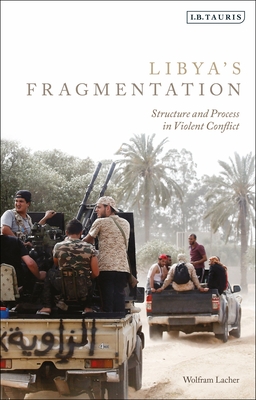
Libya's Fragmentation: Structure and Process in Violent Conflict
| AUTHOR | Lacher, Wolfram |
| PUBLISHER | Continnuum-3PL (02/20/2020) |
| PRODUCT TYPE | Hardcover (Hardcover) |
Description
After the overthrow of the Qadhafi regime in 2011, Libya witnessed a dramatic breakdown of centralized power. Countless local factions carved up the country into a patchwork of spheres of influence. Almost no nationwide or even regional organizations emerged, and no national institutions survived the turbulent descent into renewed civil war. Only the leader of one armed coalition, Khalifa Haftar, has managed to overcome competitors and centralize authority over eastern Libya. As he attempts to seize power in the capital Tripoli, dozens of armed groups in western Libya have coalesced to offer tenacious resistance.
Rarely does internal division and political fragmentation occur as radically as in Libya. This has been the primary obstacle to the re-establishment of central authority. This book analyzes the forces that have shaped the country's trajectory since 2011. Questioning widely held assumptions about the role of Libya's tribes in the revolution, Wolfram Lacher shows how war transformed pre-existing social structures and explains why Khalifa Haftar has been able to consolidate his sway over the northeast. Based on hundreds of interviews with key actors in the conflict, Lacher advances a new approach to the study of civil wars, placing the social ties of actors at the centre of analysis and exploring the link between violent conflict and social cohesion.
Rarely does internal division and political fragmentation occur as radically as in Libya. This has been the primary obstacle to the re-establishment of central authority. This book analyzes the forces that have shaped the country's trajectory since 2011. Questioning widely held assumptions about the role of Libya's tribes in the revolution, Wolfram Lacher shows how war transformed pre-existing social structures and explains why Khalifa Haftar has been able to consolidate his sway over the northeast. Based on hundreds of interviews with key actors in the conflict, Lacher advances a new approach to the study of civil wars, placing the social ties of actors at the centre of analysis and exploring the link between violent conflict and social cohesion.
Show More
Product Format
Product Details
ISBN-13:
9780755600809
ISBN-10:
0755600800
Binding:
Hardback or Cased Book (Sewn)
Content Language:
English
More Product Details
Page Count:
304
Carton Quantity:
24
Product Dimensions:
6.14 x 0.69 x 9.21 inches
Weight:
1.31 pound(s)
Feature Codes:
Bibliography,
Index,
Dust Cover,
Maps,
Illustrated
Country of Origin:
US
Subject Information
BISAC Categories
Political Science | World - Middle Eastern
Political Science | Africa - North
Political Science | Revolutions, Uprisings & Rebellions
Dewey Decimal:
961.205
Descriptions, Reviews, Etc.
publisher marketing
After the overthrow of the Qadhafi regime in 2011, Libya witnessed a dramatic breakdown of centralized power. Countless local factions carved up the country into a patchwork of spheres of influence. Almost no nationwide or even regional organizations emerged, and no national institutions survived the turbulent descent into renewed civil war. Only the leader of one armed coalition, Khalifa Haftar, has managed to overcome competitors and centralize authority over eastern Libya. As he attempts to seize power in the capital Tripoli, dozens of armed groups in western Libya have coalesced to offer tenacious resistance.
Rarely does internal division and political fragmentation occur as radically as in Libya. This has been the primary obstacle to the re-establishment of central authority. This book analyzes the forces that have shaped the country's trajectory since 2011. Questioning widely held assumptions about the role of Libya's tribes in the revolution, Wolfram Lacher shows how war transformed pre-existing social structures and explains why Khalifa Haftar has been able to consolidate his sway over the northeast. Based on hundreds of interviews with key actors in the conflict, Lacher advances a new approach to the study of civil wars, placing the social ties of actors at the centre of analysis and exploring the link between violent conflict and social cohesion.
Rarely does internal division and political fragmentation occur as radically as in Libya. This has been the primary obstacle to the re-establishment of central authority. This book analyzes the forces that have shaped the country's trajectory since 2011. Questioning widely held assumptions about the role of Libya's tribes in the revolution, Wolfram Lacher shows how war transformed pre-existing social structures and explains why Khalifa Haftar has been able to consolidate his sway over the northeast. Based on hundreds of interviews with key actors in the conflict, Lacher advances a new approach to the study of civil wars, placing the social ties of actors at the centre of analysis and exploring the link between violent conflict and social cohesion.
Show More
Your Price
$113.85