
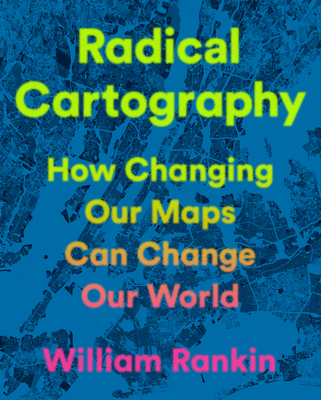
Radical Cartography: How Changing Our Maps Can Change Our World
| AUTHOR | Rankin, William |
| PUBLISHER | Viking (11/11/2025) |
| PRODUCT TYPE | Hardcover (Hardcover) |
Description
"This is it: the full download from a true genius of cartography. Radical Cartography will make you see maps, and, indeed, your place on the planet, with fresh eyes."--Daniel Immerwahr, author of How to Hide an Empire. A stunning, thought-provoking exploration of how maps shape our understanding of the world--featuring over 150 full-color maps in a gorgeous package Maps are ubiquitous in contemporary life--not just for navigation, but for making sense of our society, our environment, and even ourselves. In an instant, huge datasets can be plotted on command and we can explore faraway places in exacting detail. Yet the new ease and speed of data mapping can often lead to the same results as ever: over-simplified maps used as tools for top-down control. Cartographer and historian William Rankin argues that it's time to reimagine what a map can be and how it can be used. Maps are not neutral visualizations of facts. They are innately political, defining how the world is divided, what becomes visible and what stays hidden, and whose voices are heard. What matters isn't just the topics or the data, but how maps make arguments about how the world works. And the consequences are enormous. A map's visual argument can change how cities are designed and how rivers flow, how wars are fought and how land claims are settled, how children learn about race and how colonialism becomes a habit of mind. Maps don't just show us information--they help construct our world. Brimming with vibrant maps, including many "radical" maps created by Rankin himself and by other cutting-edge mapmakers, Radical Cartography exposes the consequences of how maps represent boundaries, layers, people, projections, color, scale, and time. Challenging the map as a tool of the status quo, Rankin empowers readers to embrace three unexpected values for the future of cartography: uncertainty, multiplicity, and subjectivity. Changing the tools--changing the maps--can change the questions we ask, the answers we accept, and the world we build.
Show More
Product Format
Product Details
ISBN-13:
9780525559795
ISBN-10:
0525559795
Binding:
Hardback or Cased Book (Sewn)
Content Language:
English
More Product Details
Page Count:
304
Carton Quantity:
12
Product Dimensions:
7.93 x 1.03 x 9.49 inches
Weight:
2.51 pound(s)
Feature Codes:
Bibliography,
Index,
Price on Product
Country of Origin:
MY
Subject Information
BISAC Categories
Social Science | Activism & Social Justice
Social Science | Graphic Arts - General
Social Science | Maps & Road Atlases (see also Reference - Atlases, Gazetteer
Dewey Decimal:
526
Library of Congress Control Number:
2025412013
Descriptions, Reviews, Etc.
publisher marketing
"This is it: the full download from a true genius of cartography. Radical Cartography will make you see maps, and, indeed, your place on the planet, with fresh eyes."--Daniel Immerwahr, author of How to Hide an Empire. A stunning, thought-provoking exploration of how maps shape our understanding of the world--featuring over 150 full-color maps in a gorgeous package Maps are ubiquitous in contemporary life--not just for navigation, but for making sense of our society, our environment, and even ourselves. In an instant, huge datasets can be plotted on command and we can explore faraway places in exacting detail. Yet the new ease and speed of data mapping can often lead to the same results as ever: over-simplified maps used as tools for top-down control. Cartographer and historian William Rankin argues that it's time to reimagine what a map can be and how it can be used. Maps are not neutral visualizations of facts. They are innately political, defining how the world is divided, what becomes visible and what stays hidden, and whose voices are heard. What matters isn't just the topics or the data, but how maps make arguments about how the world works. And the consequences are enormous. A map's visual argument can change how cities are designed and how rivers flow, how wars are fought and how land claims are settled, how children learn about race and how colonialism becomes a habit of mind. Maps don't just show us information--they help construct our world. Brimming with vibrant maps, including many "radical" maps created by Rankin himself and by other cutting-edge mapmakers, Radical Cartography exposes the consequences of how maps represent boundaries, layers, people, projections, color, scale, and time. Challenging the map as a tool of the status quo, Rankin empowers readers to embrace three unexpected values for the future of cartography: uncertainty, multiplicity, and subjectivity. Changing the tools--changing the maps--can change the questions we ask, the answers we accept, and the world we build.
Show More
Author:
Rankin, William
William Rankin is assistant professor of the history of science at Yale University. He lives in New Haven, Connecticut.
Show More
List Price $40.00
Your Price
$39.60