
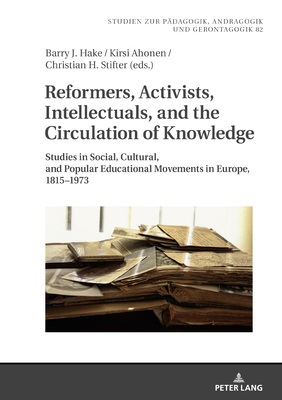
Reformers, Activists, Intellectuals, and the Circulation of Knowledge: Studies in Social, Cultural, and Popular Educational Movements in Europe, 1815-
| PUBLISHER | Peter Lang Gmbh, Internationaler Verlag Der W (05/15/2025) |
| PRODUCT TYPE | Hardcover (Hardcover) |
Civil society movements were key actors in disseminating knowledge, skills, and values to empower groups and individuals in interpreting and sharing their experiences of class, religion, gender, region, race, language, citizenship, and nationality during the differential modernisation of European societies. This volume explores the historical variations in the relationships between organised adult learning, collective and individual emancipation, and social movements in Europe during the 19th and 20th centuries. The diverse manifestations of collectively organised adult learning were characterised by institutionalised 'formal' instruction, non-formal 'mutual learning' and informal schemes of 'self-organised learning'.
The contributions collected here exemplarily span a broad field of diverse historical developments on a national and transnational European level including nationalist movements, and 'völkisch'-national-socialist manifestations.
Civil society movements were key actors in disseminating knowledge, skills, and values to empower groups and individuals in interpreting and sharing their experiences of class, religion, gender, region, race, language, citizenship, and nationality during the differential modernisation of European societies. This volume explores the historical variations in the relationships between organised adult learning, collective and individual emancipation, and social movements in Europe during the 19th and 20th centuries. The diverse manifestations of collectively organised adult learning were characterised by institutionalised 'formal' instruction, non-formal 'mutual learning' and informal schemes of 'self-organised learning'.
The contributions collected here exemplarily span a broad field of diverse historical developments on a national and transnational European level including nationalist movements, and 'völkisch'-national-socialist manifestations.