
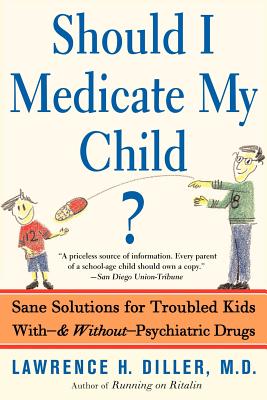
Should I Medicate My Child?: Sane Solutions for Troubled Kids With-And Without-Psychiatric Drugs
| AUTHOR | Diller, Lawrence H.; Diller, Lawrence H.; Diller, Lawrence H. et al. |
| PUBLISHER | Basic Books (04/17/2003) |
| PRODUCT TYPE | Paperback (Paperback) |
Description
When Running on Ritalin was published in 1998 it touched off a firestorm about treating children with psychiatric drugs. Dr. Lawrence Diller established himself as the leading expert on the controversial use of stimulants for attention deficit disorder. Since then, parents, physicians, teachers and psychologists, have clamored for his expertise on psychological problems beyond ADD and on drugs beyond Ritalin. More and more parents are asking the simple question: Should I medicate my child? The answer is not as simple as some "experts" say. Children who are angry, intense, distractible, over-energetic, obsessive, shy, listless, or remote rarely benefit from an either/or strategy. Unlike those with a strong pro- or anti-drug agenda, Dr. Diller advocates a balanced approach; he shows how a wise pediatrician -- one who prescribes drugs but also urges non-pharmaceutical interventions when possible -- makes decisions. Should I Medicate My Child? empowers parents to ask the same questions Dr. Diller poses in diagnosis and treatment: Have all non-drug approaches been tried? Is the diagnosis accurate? What's known (or unknown) about the recommended drug? Calmly comforting, authoritative, and illustrated with real-life examples, Should I Medicate My Child? is essential reading for parents who have been told their preschooler should be "tested" for a disorder, whose fifth-grader has been prescribed Prozac or Depakote, or whose teenager has been diagnosed with a "chemical imbalance." Should I Medicate My Child? features a detailed, easy-to-access Appendix of Frequently Prescribed Drugs -- what they do, side effects, dosages, and more. Should I Medicate My Child? answers parents' vital questions: * Is it fair to discipline my hyperactive child if he can't help himself when he misbehaves? Choosing the right kind of discipline is essential. Often the time-honored "time-out" is not the best choice.
* The psychiatrist says the medication he's prescribing is "safe." How can I know if that's true? Dr. Diller's detailed Appendix includes little-known information on how (or if) a drug has actually been tested on children.
* Does it make good sense to use medication right away? Dr. Diller explains why this can sometimes be the best course of action.
* My pediatrician says there are drugs that will help my shy six year old be more outgoing. Is this true? Prescribing drugs for withdrawn children is a risky business. Dr. Diller explains why and offers alternatives to help ease their distress.
* The psychiatrist says the medication he's prescribing is "safe." How can I know if that's true? Dr. Diller's detailed Appendix includes little-known information on how (or if) a drug has actually been tested on children.
* Does it make good sense to use medication right away? Dr. Diller explains why this can sometimes be the best course of action.
* My pediatrician says there are drugs that will help my shy six year old be more outgoing. Is this true? Prescribing drugs for withdrawn children is a risky business. Dr. Diller explains why and offers alternatives to help ease their distress.
Show More
Product Format
Product Details
ISBN-13:
9780465016464
ISBN-10:
0465016464
Binding:
Paperback or Softback (Trade Paperback (Us))
Content Language:
English
More Product Details
Page Count:
256
Carton Quantity:
26
Product Dimensions:
6.00 x 0.60 x 9.16 inches
Weight:
0.85 pound(s)
Feature Codes:
Index,
Price on Product
Country of Origin:
US
Subject Information
BISAC Categories
Family & Relationships | Parenting - General
Dewey Decimal:
618.928
Library of Congress Control Number:
2011292567
Descriptions, Reviews, Etc.
annotation
In this authoritative and plainspoken book, which features a detailed, easy-to-access "Quick Guide to Psychiatric Drugs, " Dr. Diller gives parents the tools they need to regain faith in their own judgment and make wise choices for their children.
Show More
publisher marketing
When Running on Ritalin was published in 1998 it touched off a firestorm about treating children with psychiatric drugs. Dr. Lawrence Diller established himself as the leading expert on the controversial use of stimulants for attention deficit disorder. Since then, parents, physicians, teachers and psychologists, have clamored for his expertise on psychological problems beyond ADD and on drugs beyond Ritalin. More and more parents are asking the simple question: Should I medicate my child? The answer is not as simple as some "experts" say. Children who are angry, intense, distractible, over-energetic, obsessive, shy, listless, or remote rarely benefit from an either/or strategy. Unlike those with a strong pro- or anti-drug agenda, Dr. Diller advocates a balanced approach; he shows how a wise pediatrician -- one who prescribes drugs but also urges non-pharmaceutical interventions when possible -- makes decisions. Should I Medicate My Child? empowers parents to ask the same questions Dr. Diller poses in diagnosis and treatment: Have all non-drug approaches been tried? Is the diagnosis accurate? What's known (or unknown) about the recommended drug? Calmly comforting, authoritative, and illustrated with real-life examples, Should I Medicate My Child? is essential reading for parents who have been told their preschooler should be "tested" for a disorder, whose fifth-grader has been prescribed Prozac or Depakote, or whose teenager has been diagnosed with a "chemical imbalance." Should I Medicate My Child? features a detailed, easy-to-access Appendix of Frequently Prescribed Drugs -- what they do, side effects, dosages, and more. Should I Medicate My Child? answers parents' vital questions: * Is it fair to discipline my hyperactive child if he can't help himself when he misbehaves? Choosing the right kind of discipline is essential. Often the time-honored "time-out" is not the best choice.
* The psychiatrist says the medication he's prescribing is "safe." How can I know if that's true? Dr. Diller's detailed Appendix includes little-known information on how (or if) a drug has actually been tested on children.
* Does it make good sense to use medication right away? Dr. Diller explains why this can sometimes be the best course of action.
* My pediatrician says there are drugs that will help my shy six year old be more outgoing. Is this true? Prescribing drugs for withdrawn children is a risky business. Dr. Diller explains why and offers alternatives to help ease their distress.
* The psychiatrist says the medication he's prescribing is "safe." How can I know if that's true? Dr. Diller's detailed Appendix includes little-known information on how (or if) a drug has actually been tested on children.
* Does it make good sense to use medication right away? Dr. Diller explains why this can sometimes be the best course of action.
* My pediatrician says there are drugs that will help my shy six year old be more outgoing. Is this true? Prescribing drugs for withdrawn children is a risky business. Dr. Diller explains why and offers alternatives to help ease their distress.
Show More
Your Price
$19.79