
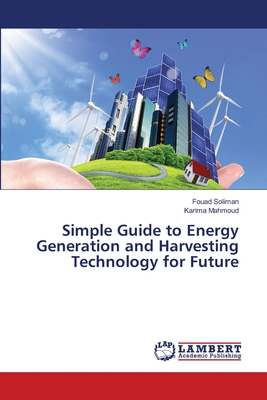
Simple Guide to Energy Generation and Harvesting Technology for Future
| AUTHOR | Mahmoud, Karima; Soliman, Fouad |
| PUBLISHER | LAP Lambert Academic Publishing (12/31/2024) |
| PRODUCT TYPE | Paperback (Paperback) |
Description
Energy harvesting-also known as power harvesting, energy scavenging, or ambient power - is the process by which energy is derived from external sources (e.g., solar power, thermal energy, wind energy, salinity gradients, and kinetic energy, also known as ambient energy), then stored for use by small, wire-less autonomous devices, like those used in wearable electronics, condition monitoring, and wireless sensor networks. It usually provides a very small amount of power for low-energy electronics. While the input fuel to some large-scale energy generation costs resources (oil, coal, etc.), the energy source for energy harvesters is present as ambient background. For example, temperature gradients exist from the operation of a combustion engine and in urban areas; there is a large amount of electromagnetic energy in the environment due to radio and television broadcasting. One of the first examples of ambient energy being used to produce electricity was the successful use of electromagnetic radiation (EMR) to generate the crystal radio. The principles of energy harvesting from ambient EMR can be demonstrated with basic components.
Show More
Product Format
Product Details
ISBN-13:
9786208420093
ISBN-10:
6208420091
Binding:
Paperback or Softback (Trade Paperback (Us))
Content Language:
English
More Product Details
Page Count:
236
Carton Quantity:
30
Product Dimensions:
6.00 x 0.54 x 9.00 inches
Weight:
0.71 pound(s)
Country of Origin:
US
Subject Information
BISAC Categories
Technology & Engineering | Electrical
Descriptions, Reviews, Etc.
publisher marketing
Energy harvesting-also known as power harvesting, energy scavenging, or ambient power - is the process by which energy is derived from external sources (e.g., solar power, thermal energy, wind energy, salinity gradients, and kinetic energy, also known as ambient energy), then stored for use by small, wire-less autonomous devices, like those used in wearable electronics, condition monitoring, and wireless sensor networks. It usually provides a very small amount of power for low-energy electronics. While the input fuel to some large-scale energy generation costs resources (oil, coal, etc.), the energy source for energy harvesters is present as ambient background. For example, temperature gradients exist from the operation of a combustion engine and in urban areas; there is a large amount of electromagnetic energy in the environment due to radio and television broadcasting. One of the first examples of ambient energy being used to produce electricity was the successful use of electromagnetic radiation (EMR) to generate the crystal radio. The principles of energy harvesting from ambient EMR can be demonstrated with basic components.
Show More
Your Price
$105.69