
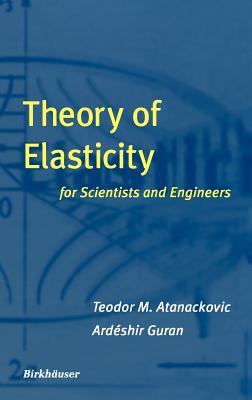
Theory of Elasticity for Scientists and Engineers
| AUTHOR | Atanackovic, Teodor M.; Guran, Ardeshir |
| PUBLISHER | Birkhauser (06/16/2000) |
| PRODUCT TYPE | Hardcover (Hardcover) |
Description
This book is intended to be an introduction to elasticity theory. It is as- sumed that the student, before reading this book, has had courses in me- chanics (statics, dynamics) and strength of materials (mechanics of mate- rials). It is written at a level for undergraduate and beginning graduate engineering students in mechanical, civil, or aerospace engineering. As a background in mathematics, readers are expected to have had courses in ad- vanced calculus, linear algebra, and differential equations. Our experience in teaching elasticity theory to engineering students leads us to believe that the course must be problem-solving oriented. We believe that formulation and solution of the problems is at the heart of elasticity theory. 1 Of course orientation to problem-solving philosophy does not exclude the need to study fundamentals. By fundamentals we mean both mechanical concepts such as stress, deformation and strain, compatibility conditions, constitu- tive relations, energy of deformation, and mathematical methods, such as partial differential equations, complex variable and variational methods, and numerical techniques. We are aware of many excellent books on elasticity, some of which are listed in the References. If we are to state what differentiates our book from other similar texts we could, besides the already stated problem-solving ori- entation, list the following: study of deformations that are not necessarily small, selection of problems that we treat, and the use of Cartesian tensors only.
Show More
Product Format
Product Details
ISBN-13:
9780817640729
ISBN-10:
081764072X
Binding:
Hardback or Cased Book (Sewn)
Content Language:
English
More Product Details
Page Count:
374
Carton Quantity:
22
Product Dimensions:
6.33 x 0.93 x 9.51 inches
Weight:
1.52 pound(s)
Feature Codes:
Illustrated
Country of Origin:
US
Subject Information
BISAC Categories
Science | Mechanics - General
Science | Mechanical
Science | Physics - Condensed Matter
Dewey Decimal:
531.382
Library of Congress Control Number:
98-16929
Descriptions, Reviews, Etc.
publisher marketing
This book is intended to be an introduction to elasticity theory. It is as- sumed that the student, before reading this book, has had courses in me- chanics (statics, dynamics) and strength of materials (mechanics of mate- rials). It is written at a level for undergraduate and beginning graduate engineering students in mechanical, civil, or aerospace engineering. As a background in mathematics, readers are expected to have had courses in ad- vanced calculus, linear algebra, and differential equations. Our experience in teaching elasticity theory to engineering students leads us to believe that the course must be problem-solving oriented. We believe that formulation and solution of the problems is at the heart of elasticity theory. 1 Of course orientation to problem-solving philosophy does not exclude the need to study fundamentals. By fundamentals we mean both mechanical concepts such as stress, deformation and strain, compatibility conditions, constitu- tive relations, energy of deformation, and mathematical methods, such as partial differential equations, complex variable and variational methods, and numerical techniques. We are aware of many excellent books on elasticity, some of which are listed in the References. If we are to state what differentiates our book from other similar texts we could, besides the already stated problem-solving ori- entation, list the following: study of deformations that are not necessarily small, selection of problems that we treat, and the use of Cartesian tensors only.
Show More
List Price $109.99
Your Price
$108.89