
ISBN 9781484077337 is currently unpriced. Please contact us for pricing.
Available options are listed below:
Available options are listed below:
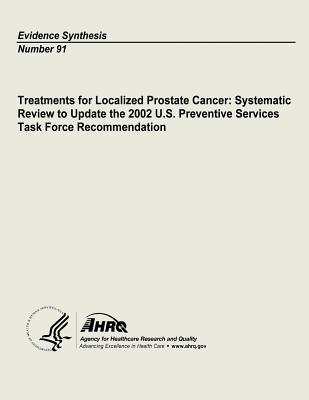
Treatments for Localized Prostate Cancer: Systematic Review to Update the 2002 U.S. Preventive Services Task Force Recommendation: Evidence Synthesis
| AUTHOR | And Quality, Agency for Healthcare Resea; Human Services, U. S. Department of Heal |
| PUBLISHER | Createspace Independent Publishing Platform (04/09/2013) |
| PRODUCT TYPE | Paperback (Paperback) |
Description
Prostate cancer is the most commonly diagnosed cancer in American men. Adenocarcinoma accounts for over 95% of all prostate cancer cases. Prostate cancer is typically staged according to the American Joint Committee on Cancer's tumor, node, metastasis (TNM) system, in which the tumor stage (T) is based on the extent of penetration or invasion beyond the prostatic capsule into adjacent structures. Localized prostate cancer is classified as stages T1 (non-palpable) and T2 (palpable) and is confined within the prostatic capsule. The likelihood of progression to invasive cancer is associated with the presence of more poorly differentiated cells and other histopathologic features. This review focuses on the benefits and harms of treatments for screen-detected prostate cancer. However, many studies do not report how prostate cancer was initially detected. Therefore, we also included studies of treatments for localized (stages T1 and T2) prostate cancer, which is far more frequently detected by screening than more advanced cancer. Among newly diagnosed patients in 2004-2005, 94% had clinically localized prostate cancer. Screening with prostate-specific antigen (PSA) testing can detect prostate cancer in earlier, asymptomatic stages, when treatments might be more effective. In 2008, based on an earlier systematic review that focused on studies of PSA-based screening versus no screening, the U.S. Preventive Services Task Force (USPSTF) found insufficient evidence to determine the balance of benefits and harms associated with prostate cancer screening in men younger than age 75 years (I statement), and recommended against screening in men ages 75 years or older (grade D recommendation). Once prostate cancer has been detected by screening, treatments are frequently initiated. Understanding the benefits and harms associated with such treatments is therefore critical for informing screening decisions. Evidence on benefits and harms of treatments for localized prostate cancer was last reviewed by the USPSTF in 2002. This report summarizes the evidence on benefits and harms of treatment for screen-detected or early-stage prostate cancer, with an emphasis on studies published since 2002.
Show More
Product Format
Product Details
ISBN-13:
9781484077337
ISBN-10:
1484077334
Binding:
Paperback or Softback (Trade Paperback (Us))
Content Language:
English
More Product Details
Page Count:
132
Carton Quantity:
30
Product Dimensions:
8.50 x 0.28 x 11.02 inches
Weight:
0.71 pound(s)
Country of Origin:
US
Subject Information
BISAC Categories
Medical | Research
Descriptions, Reviews, Etc.
publisher marketing
Prostate cancer is the most commonly diagnosed cancer in American men. Adenocarcinoma accounts for over 95% of all prostate cancer cases. Prostate cancer is typically staged according to the American Joint Committee on Cancer's tumor, node, metastasis (TNM) system, in which the tumor stage (T) is based on the extent of penetration or invasion beyond the prostatic capsule into adjacent structures. Localized prostate cancer is classified as stages T1 (non-palpable) and T2 (palpable) and is confined within the prostatic capsule. The likelihood of progression to invasive cancer is associated with the presence of more poorly differentiated cells and other histopathologic features. This review focuses on the benefits and harms of treatments for screen-detected prostate cancer. However, many studies do not report how prostate cancer was initially detected. Therefore, we also included studies of treatments for localized (stages T1 and T2) prostate cancer, which is far more frequently detected by screening than more advanced cancer. Among newly diagnosed patients in 2004-2005, 94% had clinically localized prostate cancer. Screening with prostate-specific antigen (PSA) testing can detect prostate cancer in earlier, asymptomatic stages, when treatments might be more effective. In 2008, based on an earlier systematic review that focused on studies of PSA-based screening versus no screening, the U.S. Preventive Services Task Force (USPSTF) found insufficient evidence to determine the balance of benefits and harms associated with prostate cancer screening in men younger than age 75 years (I statement), and recommended against screening in men ages 75 years or older (grade D recommendation). Once prostate cancer has been detected by screening, treatments are frequently initiated. Understanding the benefits and harms associated with such treatments is therefore critical for informing screening decisions. Evidence on benefits and harms of treatments for localized prostate cancer was last reviewed by the USPSTF in 2002. This report summarizes the evidence on benefits and harms of treatment for screen-detected or early-stage prostate cancer, with an emphasis on studies published since 2002.
Show More