
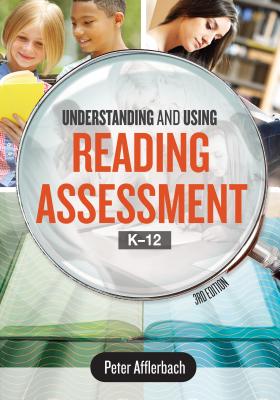
Understanding and Using Reading Assessment, K-12
| AUTHOR | Afflerbach, Peter |
| PUBLISHER | ASCD (12/20/2017) |
| PRODUCT TYPE | Paperback (Paperback) |
Why do we assess reading? What do we assess when we assess reading? How, where, and when do we assess reading? Reading instruction and assessment expert Peter Afflerbach addresses these questions and much more in the 3rd edition of Understanding and Using Reading Assessment, K-12.
Using the CURRV model to evaluate reading assessment methods--including reading inventories, teacher questioning, performance assessment, and high-stakes reading tests--Afflerbach considers the consequences and usefulness of each method, the roles and responsibilities of key stakeholders, and the reliability and validity of the assessments. In addition, he examines four important but often overlooked aspects of reading assessment:
- Assessment accommodation for English-language learners and students with special needs
- Assessment of noncognitive aspects of reading, such as motivation, engagement, self-concept, and self-efficacy
- The use of formative and summative assessment
- The importance of self-assessment in building reading independence
The book provides detailed case studies from all grade levels to illustrate reading assessment done well. It also includes 15 reproducible forms and checklists that teachers and administrators can use to optimize their reading assessment efforts.
Students are expected to read increasingly complex texts and to complete increasingly complex reading-related tasks to demonstrate their growth as readers. This book offers teachers and administrators alike a clear path to helping students meet those expectations.
This book is a co-publication of ASCD and ILA.
New to the 3rd edition:
- New chapter "Formative and Summative Assessment"
- Three significantly revised chapters--Performance Assessment; Assessment Accommodation for English Learners and Students With Special Needs ("Accommodation and Reading Assessment" in 2nd edition); Assessing "the Other" Important Noncognitive Aspects of Reading
- Fifteen reproducible and downloadable forms and checklists
Why do we assess reading? What do we assess when we assess reading? How, where, and when do we assess reading? Reading instruction and assessment expert Peter Afflerbach addresses these questions and much more in the 3rd edition of Understanding and Using Reading Assessment, K-12.
Using the CURRV model to evaluate reading assessment methods--including reading inventories, teacher questioning, performance assessment, and high-stakes reading tests--Afflerbach considers the consequences and usefulness of each method, the roles and responsibilities of key stakeholders, and the reliability and validity of the assessments. In addition, he examines four important but often overlooked aspects of reading assessment:
- Assessment accommodation for English-language learners and students with special needs Assessment of noncognitive aspects of reading, such as motivation, engagement, self-concept, and self-efficacy
- The use of formative and summative assessment
- The importance of self-assessment in building reading independence
The book provides detailed case studies from all grade levels to illustrate reading assessment done well. It also includes 15 reproducible forms and checklists that teachers and administrators can use to optimize their reading assessment efforts.
Students are expected to read increasingly complex texts and to complete increasingly complex reading-related tasks to demonstrate their growth as readers. This book offers teachers and administrators alike a clear path to helping students meet those expectations.
This book is a co-publication of ASCD and ILA.
Why do we assess reading? What do we assess when we assess reading? How, where, and when do we assess reading? Reading instruction and assessment expert Peter Afflerbach addresses these questions and much more in the 3rd edition of Understanding and Using Reading Assessment, K-12.
Using the CURRV model to evaluate reading assessment methods--including reading inventories, teacher questioning, performance assessment, and high-stakes reading tests--Afflerbach considers the consequences and usefulness of each method, the roles and responsibilities of key stakeholders, and the reliability and validity of the assessments. In addition, he examines four important but often overlooked aspects of reading assessment:
- Assessment accommodation for English-language learners and students with special needs
- Assessment of noncognitive aspects of reading, such as motivation, engagement, self-concept, and self-efficacy
- The use of formative and summative assessment
- The importance of self-assessment in building reading independence
The book provides detailed case studies from all grade levels to illustrate reading assessment done well. It also includes 15 reproducible forms and checklists that teachers and administrators can use to optimize their reading assessment efforts.
Students are expected to read increasingly complex texts and to complete increasingly complex reading-related tasks to demonstrate their growth as readers. This book offers teachers and administrators alike a clear path to helping students meet those expectations.
This book is a co-publication of ASCD and ILA.
New to the 3rd edition:
- New chapter "Formative and Summative Assessment"
- Three significantly revised chapters--Performance Assessment; Assessment Accommodation for English Learners and Students With Special Needs ("Accommodation and Reading Assessment" in 2nd edition); Assessing "the Other" Important Noncognitive Aspects of Reading
- Fifteen reproducible and downloadable forms and checklists