
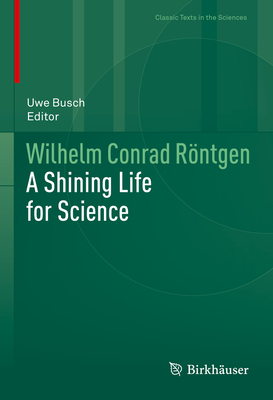
Wilhelm Conrad Röntgen: A Shining Life for Science
| PUBLISHER | Birkhauser (10/10/2021) |
| PRODUCT TYPE | Hardcover (Hardcover) |
It was one of the great moments of humanity when Wilhelm Conrad R ntgen (1845-1923) discovered a new type of radiation on 8 November 1895. He himself modestly called them "X-rays". His name and his rays became world famous. On December 1901, R ntgen received the first Nobel Prize in Physics for the discovery and research of the X-rays named after him. X-rays have lost none of their appeal since then. They still permeate all areas of science and technology and accompany us in our everyday lives.
However, R ntgen's scientific work cannot be reduced to this one great discovery alone. He was an excellent natural scientist, and his spirit of research is still an example for many scientists today. His special field of precision physics is also more topical than ever.
This carefully curated volume offers a multifaceted view of the outstanding natural scientist and provides insights into his personal legacy.
It was one of the great moments of humanity when Wilhelm Conrad Rntgen (1845-1923) discovered a new type of radiation on 8 November 1895. He himself modestly called them "X-rays". His name and his rays became world famous. On December 1901, Rntgen received the first Nobel Prize in Physics for the discovery and research of the X-rays named after him. X-rays have lost none of their appeal since then. They still permeate all areas of science and technology and accompany us in our everyday lives.
However, Rntgen's scientific work cannot be reduced to this one great discovery alone. He was an excellent natural scientist, and his spirit of research is still an example for many scientists today. His special field of precision physics is also more topical than ever.
This carefully curated volume offers a multifaceted view of the outstanding natural scientist and provides insights into his personal legacy.
This book is a translation of an original German edition. The translation was done with the help of artificial intelligence (machine translation by the service DeepL.com). A subsequent human revision was done primarily in terms of content, so that the book will read stylistically differently from a conventional translation.
It was one of the great moments of humanity when Wilhelm Conrad R ntgen (1845-1923) discovered a new type of radiation on 8 November 1895. He himself modestly called them "X-rays". His name and his rays became world famous. On December 1901, R ntgen received the first Nobel Prize in Physics for the discovery and research of the X-rays named after him. X-rays have lost none of their appeal since then. They still permeate all areas of science and technology and accompany us in our everyday lives.
However, R ntgen's scientific work cannot be reduced to this one great discovery alone. He was an excellent natural scientist, and his spirit of research is still an example for many scientists today. His special field of precision physics is also more topical than ever.
This carefully curated volume offers a multifaceted view of the outstanding natural scientist and provides insights into his personal legacy.